Here are some cover images for the Microsoft Systems Journal. Enjoy the graphic design of the early 90s:


Here are some cover images for the Microsoft Systems Journal. Enjoy the graphic design of the early 90s:
Julien Voisin posted this snippet for embedding Youtube videos on a page in a way that reduces Youtube’s invasive tracking:
<iframe
    credentialless
    allowfullscreen
    referrerpolicy="strict-origin-when-cross-origin"
    sandbox="allow-scripts allow-same-origin"
    allow="accelerometer 'none'; ambient-light-sensor 'none'; autoplay 'none'; battery 'none'; bluetooth 'none'; browsing-topics 'none'; camera 'none'; ch-ua 'none'; display-capture 'none'; domain-agent 'none'; document-domain 'none'; encrypted-media 'none'; execution-while-not-rendered 'none'; execution-while-out-of-viewport 'none'; gamepad 'none'; geolocation 'none'; gyroscope 'none'; hid 'none'; identity-credentials-get 'none'; idle-detection 'none'; keyboard-map 'none'; local-fonts 'none'; magnetometer 'none'; microphone 'none'; midi 'none'; navigation-override 'none'; otp-credentials 'none'; payment 'none'; picture-in-picture 'none'; publickey-credentials-create 'none'; publickey-credentials-get 'none'; screen-wake-lock 'none'; serial 'none'; speaker-selection 'none'; sync-xhr 'none'; usb 'none'; web-share 'none'; window-management 'none'; xr-spatial-tracking 'none'"
    csp="sandbox allow-scripts allow-same-origin;"
    width="560"
    height="315"
    src="https://www.youtube-nocookie.com/embed/jfKfPfyJRdk"
    title="lofi hip hop radio 📚 - beats to relax/study to"
    frameborder="0"
    loading="lazy"
></iframe>
Just change the video URL + video Title that are bolded.
At least Google can still find that full song from a fragment of the lyrics 🤡

Google’s search quality is bad, so it’s nice to see that it still works sometimes.
I frequently say “the best decade for music is right now, not some golden age in the past”. Well… maybe not when it comes to lyrics.
But seriously, J-Wax’s Nasty is a bop.

I have a small collection of minerals. If you’ve had the misfortune of listening to my “I went to Calgary and got to visit 3 BIG MINERAL STORES and also SCRABBLE IN THE DIRT FOR FOSSILS” speech, then you might be wondering what’s wrong with this adult man.
One of the themes and joys of this mineral collection is the Permadance.
(more…)We are in the Arabian Desert.
Crisp, hot air. Ibex prancing on craggy cliffs. Plucky shrubs. Frankincense.
And sand. Lots of sand.
Dear reader, today we are tasting Pretzel Sand.

The first thing to note about this treat is the graphic design. Look how great the colour palette is. The graphics are on-point.
We open the box. It contains 6 little baggies with 2 cookies in each. Great for packing in a lunchbox for a kid – or for yourself!
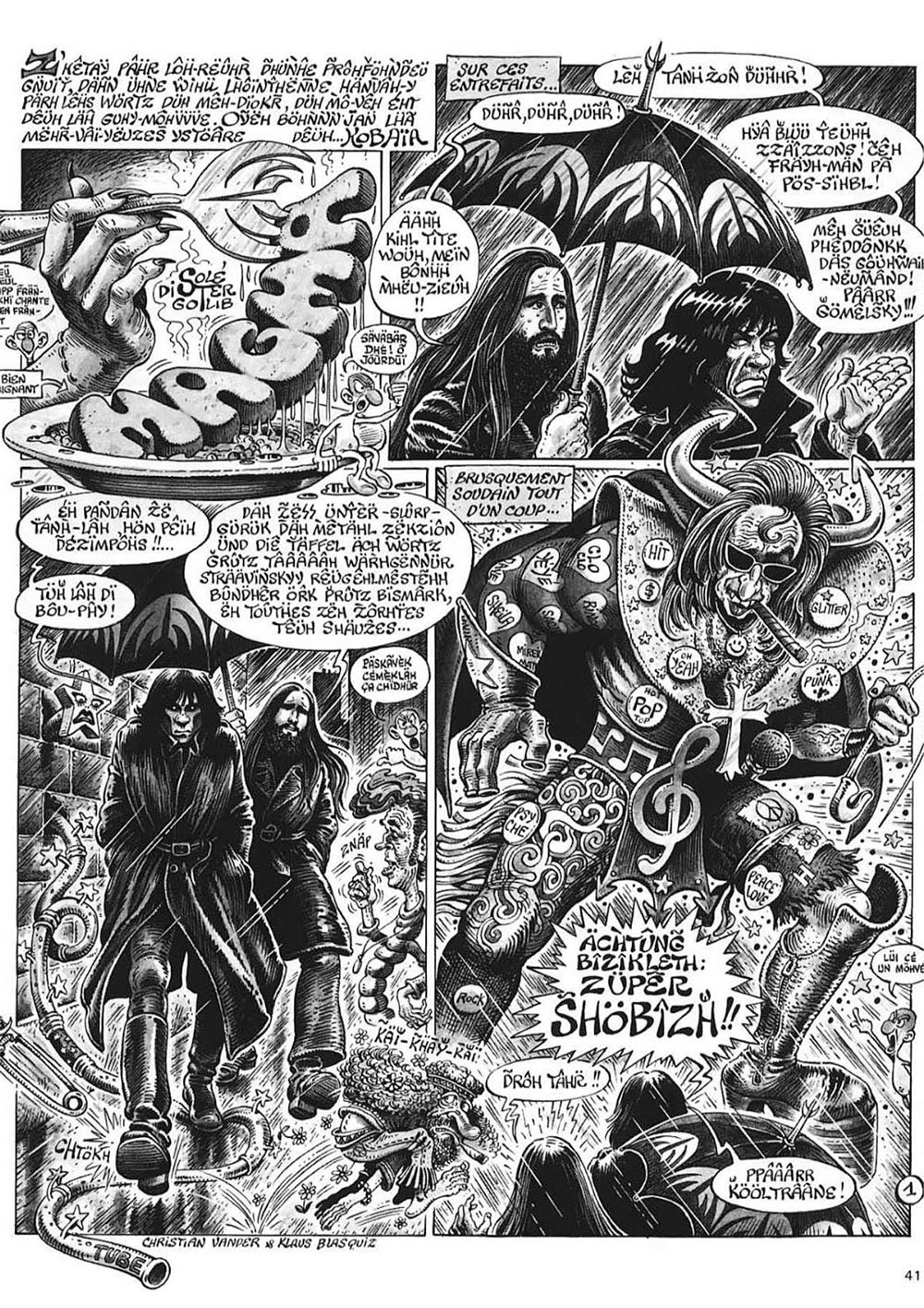
(more…)Hey, inventing your own language isn’t just for brainiacs like J.R.R. Tolkien and Paul Frommer who invented the language spoken in 3D stinker Avatar.
Cool rocker guys – like Christian Vander of the band Magma – can also invent their own languages when none of Earth’s languages sound just right:
You might’ve heard songs where musician used nonsense words in their music, like Phil Collins’ Ssudio and Chacarron. But Magma’s Kobaïan language is true commitment!
(Discovered through this fun list of song, artist and album titles that give database designers nightmares)
[Feb. 2026 update]
John Coulthart has a new post with more information about the Zeuhl language, offshoot bands and artists who were influenced by Magma.
This post is about the tools and techniques you would use to “digitally preserve a physical place”. To gather the digital imagery connected to a geographical area and to download it for yourself.
This is also a “behind the scenes” look at how I made my post “A place I’ve never been to. A place I’ll never go.” I started research for that post on March 26, 2024 and hit “publish” on April 12, 2024.
Below is a song to set the mood: Anemoia – “nostalgia for a time you’ve never known.
Let’s get started.
“Market Village” at 4390 Steeles Ave. East.
It’s a mall just North of Toronto.
I’ve always wanted to visit Market Village, but I never will.
And neither will you.

I mean, don’t get me wrong. If you go online the mall looks quite lively. Google Maps shows it where it’s always been. There on the right, next to “Pacific Mall”. You can even see the internal layout if you look closely.
Elsewhere, map markers show you the stores in the mall. With reviews and pictures and everything:

But if you and I get in the car and drive there – no, don’t put your feet there. I borrowed the car from my Mother and I don’t wanna mess it up! Listen, if you and I get in the car then this is what we’ll see when we get there:
(more…)
Microsoft Research created a tool called ICE for automatically stitching together many pictures into a panorama / composite. It is no longer available from Microsoft, but here are backed up copies for download:
(And here is a link for the 64 bit download on CNET)
(more…)Note: as of May 2025 the code in this post does not work.
What works for photospheres is turning a photosphere viewing URL like:
https://www.google.com/maps/place/Borot+Lots+Campground/@30.5021229,34.6319275,3a,75y,315.58h,91.88t/data=!3m8!1e1!3m6!1sCIHM0ogKEICAgIDqy52-jAE!2e10!3e11!6shttps:%2F%2Flh3.googleusercontent.com%2Fgpms-cs-s%2FAB8u6HZTukqE-3smpL_xzpTY2oWZNf7zn4T9jQhVDBJ_TG-ZQWFgjvuo2jVKWya-CX4xEf7-6igY7SqslnHdxUxDlTxP7xlJRUKlDPxEtrJW5buM4pmHoaS-Uu3d-SemgpSD6Onfr3icog%3Dw900-h600-k-no-pi-1.8781544128473797-ya207.57962850748117-ro0-fo100!7i12800!8i3890!4m7!3m6!1s0x1501e72618987fe3:0x3f575221900fd9c6!8m2!3d30.5135718!4d34.6086344!10e5!16s%2Fg%2F11cnd55nkj?entry=ttu&g_ep=EgoyMDI1MDUwNi4wIKXMDSoASAFQAw%3D%3Dinto this URL:
https://lh3.googleusercontent.com/gps-cs-s/AB8u6HZTukqE-3smpL_xzpTY2oWZNf7zn4T9jQhVDBJ_TG-ZQWFgjvuo2jVKWya-CX4xEf7-6igY7SqslnHdxUxDlTxP7xlJRUKlDPxEtrJW5buM4pmHoaS-Uu3d-SemgpSD6Onfr3icog=s8000-k-noHere is how you can download imagery from Google Maps onto your own computer.
This method involves bookmarklets – special bookmarks that run custom javascript code on the page you are visiting. Steps:
Repeat steps 3 through 5 for as many images/photospheres/streetviews as you wish!
(more…)