This post is not a review – it’s just a page about my favourite prepackaged coffee. I like drinking this Coco Bruni Americano coffee pouch. It is available here in Toronto at the “Galleria” Korean grocery chain.
When it disappeared from the store, I couldn’t find it again because I didn’t know the brand. Now that it is back, I’ve created this post as a way for others to find this brand through general search phrases.
The phrases I most associate with it:
Girl on a bird coffee
Girl riding a bird coffee pouch
Korean coffee pouch drink
Coco Bruni coffee
The design of these pouches is really something. There is an inflated handle for you to comfortable hold it. You can tear off the tip and pour the coffee into a cup, or you could use the telescoping straw to drink this like an adult juice pouch.
These Coco Bruni pouches seem to be associated with a fancy cafe based in Seoul, South Korea:
Hana no Shiori – which translates to something like “Pressed Flower Bookmark” was a Japanese printers’ exchange. It was a compilation of the finest Japanese letterpress work of the late 19th century.
The the Tokyo Tsukiji Type Foundry published Hana no Shiori, and there were 5 volumes:
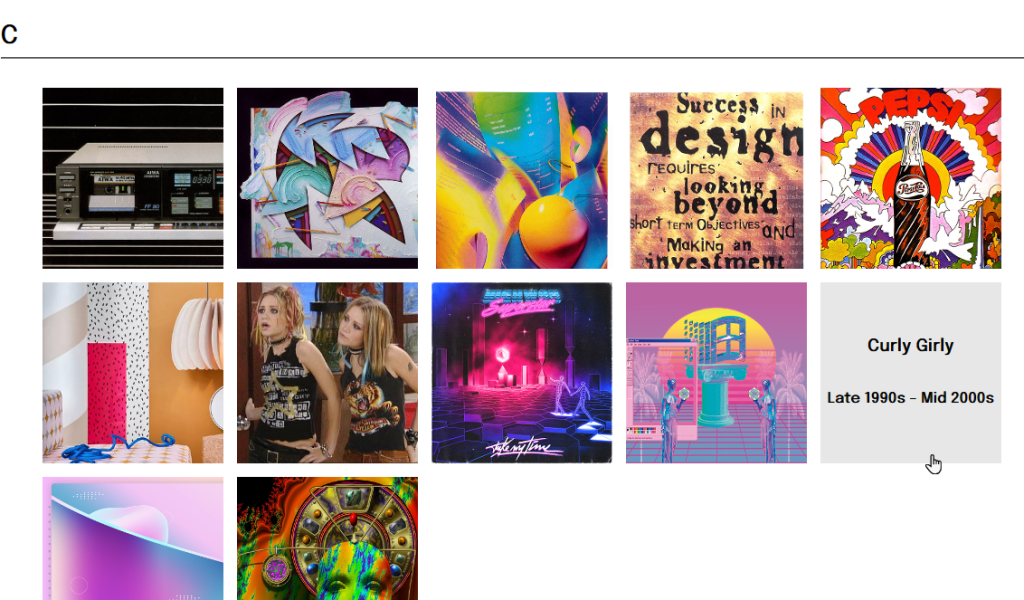
My comments: many of these images feature bent-rule work. It is the art of making a picture by using snippets of ~1cm tall pieces of flat metal. Part of creating the picture involves the use of wooden blocks to hold the metal wires in place tightly.
A LOT of very finnicky rule-work went into this picture. I have no idea how the sakura flowers on the kimono were done – perhaps with pre-cast “printers’ ornaments” that were filed down or masked-off in the final print?A house made out of printers’ ornaments – this is a different kind of manual artwork than rule-work
This is very much in the style of western “Artistic Printing”Incredible work – made with bent copper “rules” and remixed borders & printers’ ornaments.
I can see at least 11 distinct colours here – the rest would’ve been created by overprinting different colours with each other. Imagine passing 11 different plates through the press, all perfectly aligned, to get this picture.
Just a little too late. Never enough to swallow those pills – now I’m sick. And always will be.
Curve – Coast is Clear
Leaky Websites
Melonking’s leaky webring – I was on a site, and it started filling up with water 😕. But fortunately it gave me a chance to bail the site and lower the level of water. That’s how I found out about Melonking’s super creative Leaky Ring:
(If you’ve never experienced Melonking’s site, he’s on the very far end of the Indieweb spectrum. You can even get a gif pet for your site from MK.)
Huffin’ it
This is one of those egregious examples where academics are huffing their own perfume so hard that they forgot what a real flower smells like:
The article proposes archival thinking as an analytical framework for studying Facebook. Following recent debates on data colonialism, it argues that Facebook dialectically assumes a role of a new archon of public records, while being unarchivable by design. It then puts forward counter-archiving – a practice developed to resist the epistemic hegemony of colonial archives – as a method that allows the critical study of the social media platform, after it had shut down researcher’s access to public data through its application programming interface. After defining and justifying counter-archiving as a method for studying datafied platforms, two counter-archives are presented as proof of concept. The article concludes by discussing the shifting boundaries between the archivist, the activist and the scholar, as the imperative of research methods after datafication.
… and this is from a cool academic who’s writing about a topic I’m passionate about (archiving Facebook despite its archive-hostile design). All this talk about decolonializing the datafied infospace to counter the neocolonial antiarchives of Zuck- and Zuck-adjacent Bergs reminds me of the World’s First Matcha Labubu Genocide.
Cukak Remixes
Yooooo, did you know that Vietnam is friggin’ rocking it on the music front? If you want to listen to fantastic “put a donk on it” remixes of Vietnamse songs, that’ll have you going “ting ting ting ting ting” mentally for days, then check out Cukak:
You know what, let’s throw in a Korean artist too – Minsu. There’s so much going on musically in Korea, even aside from K-Pop:
On her channel, there are English lyric sheets for all the songs in this album.
Snackbonmination
Frankly, reading this article had my physiognomy contorted in distaste:
Just… the awful crossovers, the amount of slop that is being produced. Some poor suckers had to formulate these abominations, procure and install the factory tooling to produce this ick, create and print the packaging. Nobody wants this. It’s sick.
I can’t quite articulate what makes these snacks so much worse than the weirdly-named ones that I like to try. I think it’s the low-effort mashup nature of it: let’s combine Cinnamon Toast Crunch and El Paso! Let’s put marsmallows into instant noodles!
The trick is to go to the “Gallery” view on the top right, set the geography to one of the capitals of the Muslim/steppe republics of the former Soviet Union and the date range to 1986-1996 and just … bodysurf through the waves of history.
PXL2000
The PXL2000 – A toy video camera that recorded onto audio cassettes.
Cherkizovsky Market
It was fascinating to read this article about a Moscow market that functioned, essentially, as it’s own fiefdom. In the racist hellhole that is Russia, this was a rare place where multiple cultures could coexist.
And there’s a fascinating analysis of how the vast, vast market was constructed. It was made of storage containers that were piled in 2 storeys. The bottom container was the shop, and the top was living quarters. The path between the containers was covered with a lightweight canopy to protect shoppers from the weather.
Lobsang Rampa – from prosthesis fitter in Devon, to hosting the spirit of a Tibetan Lama, then becoming a bestselling author, and finally retiring in Calgary.
Making art by hand teaches my daughter—and me—things that cannot be learned by prompting:
Material constraints. What do we have to work with? How do these pieces fit together? What can we make from what we have?
Physical manipulation. How does this paper feel? How does it tear? How does glue behave? How do colors interact when they’re actually touching? How does the physicality of a material affect what we later see?
Aesthetic judgment. Does this feel right here? What happens if I move it? What does this composition need?
The satisfaction of making something exist that didn’t before. Of putting yourself into it. Of leaving traces of your decisions in the final object.
It just struck me: when the AI mania passes, after the awful way in which AI is being forced down our throats there’s going to be a PTSD period when people will want nothing to do with AI even in cases where it’s genuinely useful.
PastVu is a great site for finding historical photos from specific locations on a map. The interface is only partly in English, but it is easy enough browse the map to find pictures in a specific area.
There is also a slightly-confusing search function. Here is an example link to a filter specifying images from Tashkent between 1993 and 1999.
While PastVu is particularly rich in pictures from Eastern Europe, there are many user-contributed photos covering North America and other regions.
Here is an example of the kind of pictures you’ll find – these are from a 1990s Moscow market that specialized in bootleg software and VHS tapes:
The market was called “Gorbushka” (Горбушка).
For a similar “Wayback StreetView” experience covering Toronto, check out OldTO.org.
We’ve baked the concept of “countries” into the Internet domain system. And that makes domain names tied to real-world territorial conflicts, countries splitting apart and countries going underwater (like Tuvalu)
.yu is an early example of something that will happen more and more often.
It is unfortunate that we didn’t preserve the .yu domain space like a nostalgic Internet memorial to the country. Instead, the sites became unmoored and unreachable.
Kaloyan referred to the research paper “What does the Web remember of its deleted past? An archival reconstruction of the former Yugoslav top-level domain” by Anat Ben-David. In that paper, Ms. Ben-David reconstructed a network graph of .yu domains from the Internet Archive’s Wayback Machine.
Ben-David’s paper used the below sources as seed lists:
By crawling links from these pages to other .yu URLs, she eventually found 17,460 unique websites in the .yu domain.
The adventure begins
Dear Reader: after hearing all this, I bellowed out a mighty
Akshuallyyyyyyyy!
I dropped my bag of mini M&Ms onto the house robe I was wearing. Unshaven and red eyed, I yelled up from the basement: “MOM, fire up the router! I’m going on an Internet Adventure!!!!”.
You see, I figured I was good enough to discover all the archived domains under the .yu TLD. After all, last time I had an akshually moment, good things happened!
At first I tried doing a wildcard search for all *.yu domains at the Wayback Machine. That didn’t work.
The CDX API – a dead(ish) end
Then, I discovered that the Wayback Machine has a “CDX Server” API that can tell us if a page is archived or not.
Below is an example of a CDX query that grabs all the unique file paths at the domain “jacobfilipp.com”, filters them down only to HTML files that were successfully fetched (status starts with a 2), and shows you only the first 10 that are archived at the Wayback Machine.
Unfortunately you can’t easily fetch all archived URLs under the TLD “.yu”. However, if you try, you get a message that says “Forbidden: This type of CDX query requires authorization.” Which tells me that you could do this if you politely ask the staff at the Internet Archive.
What does work is fetching all the files under the Yugoslavian subdomains like *.co.yu and *.org.yu and *.ac.yu.
Here is an example of fetching all the URLs under *.co.yu:
I went ahead and used my newfound CDX skills to download a list of all indexed “domain listing” pages. Not all of them are in the Wayback Machine: most listings stop at “page 20” of each letter.
Then, I downloaded all those pages locally using wget (use the id_ URL trick to get a page with un-altered URLs), and extracted all the .yu domain names from the links inside.
Finally, looping through each domain name, I used the CDX endpoint to check whether the domain is in the Archive or not.
End result:
21,864 domains with 13,292 of them having an archived copy in the Wayback Machine.
While writing this post, I realized that the parent of www.yu – memodata.net – also has a list of domains. Theoretically it is the same list of domains. But, practically, the Wayback Machine might have indexed alphabetical listing pages that it didn’t index for www.yu. You’d have to grab all the listings pages using the CDX API and extract the domains.
If you really need more .yu domains, Nikola Smolenski and Anat Ben-David are easy to find online. You should ask them nicely – I bet they have their lists saved somewhere.
This is a list of restrictive grocery covenants from across Canada. All the Halifax covenants were graciously shared by Jenna Khoury-Hanna. I paid for the rest of them – now they are available to you for free.
I am asking for your help: contact me if you spot any mistakes, or if you are aware of a restrictive covenant that should be on this list. My email is “jacob” at this website.
What are restrictive covenants?
“Restrictive Covenants” are a tool that Canada’s biggest grocers use to block competing groceries from moving in to certain locations. The Competition Bureau is currently investigating the harms that stem from this.
The concept of Restrictive Covenants is long-established in real estate: it is a restriction on the use of land for certain purposes. For example, it could block you from opening a smelly petting zoo on your property. Historically, they were used to keep out members of minority races from neighbourhoods in the USA and in Canada.
Covenants typically “travel with the land” – this means that they bind all future owners of the land. Sometimes in perpetuity. Covenants override municipal zoning rules.
Here is a clear summary of how grocers use covenants to reduce competition, from a 2023 Grocery Market study by the Competition Bureau of Canada:
They explain why covenants are rarely challenged in practice:
Although it appears that the use of restrictive covenants to inhibit competition is found in a number of commercial realms, there is rarely an incentive on the part of would-be purchasers to challenge the validity of a restriction. Why mount an assault if there are ample alternative business sites? … At the same time, a rival business might not wish to invalidate the restriction even ignoring the time, expense and uncertainty surrounding that kind of legal action. After all, that firm might want to free-ride on the restriction by locating near to the restricted parcel, since it is likely that a competitor will not try to set up shop on the restricted site.
List of grocery covenants
Toronto, ON: 985 Woodbine Ave.
Lease between Valu-Mart (Loblaws) and CP REIT (Loblaws).
This is a Lease agreement preventing anyone from selling groceries on the territory of a shopping block while the Valu-Mart is in operation.
What’s interesting is that this one lease also blocks the Landlord from leasing property to any other grocer within a 2 Kilometre radius of the shopping centre. The landlord in this case is CP REIT – Canada’s largest real estate investment trust, and you can bet that they own land nearby*.
* Actually, I will owe you an update: CP REIT discloses all their properties, and I will check whether any major ones are within that radius. The adjoining ones on Danforth Ave. are definitely owned by CP REIT.
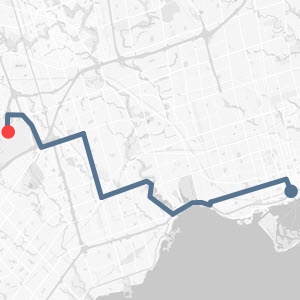
Here is a visualization of the “no grocery leasing” area that’s covered. This is a big urban swath of land. It covers the distance of 5 subway stations.
This is a 2004 deal between Loblaws and RioCan. Currently operating as “Your Independent Grocer”, a misleadingly-named subsidiary of Loblaws.
The highlighted passage shows the kinds of activities that are restricted. Section 2 illustrates the power of a Restrictive Covenant to bind future owners of the land. The restrictions are in place as long as Loblaws is operating on the property, and for 6 months afterwards – which makes it one of the more reasonable covenants on this page.
Question for readers who are Lawyers: what does section 3 mean? Does the covenant expire if Loblaws stops operating for 6 months in the future, or does it expire only if Loblaws fails to operate a store for just the initial 6 month period after the covenant is added?
This is a lease agreement for a shopping plaza, where Metro put in a “Food Basics” grocery. It forbids other tenants from selling foods while the tenancy is active:
What’s interesting is that the lease outlines in minute detail what foods, and how much of each, a potential Shoppers Drug Mart is allowed to sell. There are strict limits on how much bread can be sold. In what other context is one business allowed to control another business’ operations in such detail? Is this what you would call free-market competition?
This is a 20-year lease agreement between Sobeys and “Picton Properties Inc.”
In this shopping plaza, none of the other tenants are allowed to sell food or non-alcoholic beverages without Sobey’s permission. There is also a 3 Kilometre radius restriction placed on Picton Properties Inc. – they can’t rent their other land to a grocer.
Dear Lawyer readers: I’m not clear if this covenant runs with the land independently of the lease. Could you please weigh in?
This lease has a whopper of a clause where Sobeys permits any Dollar Store tenants to sell name-brand non-perishables. But only if they never undercut Sobey’s price (ie. use them as a “loss leader”). If this happens, the landlord is obligated to prevent selling National Brand goods.
This is the same block of properties as “Crestwood Centre” at 9604 142 St NW.
This is a covenant that was connected to a year 2000 lease with Great Pacific Industries (“Save-on-Foods”). It only lasted as long as the tenancy – so it didn’t “carry with the land” for an unreasonable span. While it was in force it forbid other tenants in the plaza from selling foods.
The covenant also includes a restriction on cinemas, spas and gyms, under the rationale that they place undue burden on parking facilities. They also block adult book stores under the same logic… which doesn’t seem consistent.
This property has a LINC identifier of 0027588798, and the restrictive covenant is registered as document 002193697.
In this document Sobeys, the owner of the “dominant lands” on the Northwest corner at 97 St. NW and 137 Ave. NW, places a restrictive covenant on the owners of the land on the Southwest corner:
The “subservient lands” on the Southwest corner are currently a Ford dealership. The owner is prevented from renting the premises to a supermarket for a whopping 60 years. This contract was signed in 2014, so it’ll be 2074 before a grocery store can even think of moving in!
A previous restrictive covenant from 2005 indicates that there used to be a Sobeys (“Garden Market”) on the site of the Ford dealership. In the older covenant a diagonal slice of the property is forever blocked from becoming a grocery:
The parcel in question. There covenant also extensively talks about a right of way between the owner of that land (Bear Creek Properties Inc.) and the adjoining Sobeys property.
This is a large lot that stayed unused for at least 12 years when Safeway left and nuked it with a restrictive covenant. Eventually, a Long & McQuade musical instrument store moved in. Take a lookat this series of Google Streetview pictures of the location:
The covenant on this one is interesting because it prevents a grocery/food store on the property for as long as 3 other Safeway (Sobeys) locations remain functioning:
Are those 3 “dominant tenants” still functioning as grocers in 2026?
8118 118 Ave. NW is currently a FreshCo. (a brand of Sobeys – which took over Safeway Canada)
At Manning Crossing in Edmonton, there is a Safeway:
3210 118 Ave NW ceased being a grocery, and is now an “Amazone Playzone”. I wouldn’t be surprised if Safeway also put a restrictive covenant on that property when they left.
This Vancouver city policy report from 1998 (backup) describes the location as: 1650 Davie Street is a former SuperValu site, currently occupied by London Drugs. In 1996, Loblaw’s (SuperValu) agreed to give up their lease provided the site’s owner agreed to a covenant restricting the use of the property for the sale of food. This covenant runs with the leases of the nearby stores it is meant to benefit (1030 Denman Street and 1255 Davie Street) and is automatically renewed with renewal of those leases.
The 1030 Denman location has a NoFrills (as of March 2026) and 1255 Davie has a “Your Independent Grocer” – both Loblaws’ brands. So the covenant is very much still active.
Here is the restriction on the % of floor space that can be used for groceries:
And the condition that ties this to the other leases, with those relevant “dominant lands” parcel identifiers:
The below restrictive covenants for Halifax were captured in 2019 and may not be valid at this time. These covenants were generously provided by Jenna Khoury-Hanna.
84 Main St. (Dartmouth) & 10 Gordon Ave.
In this one, Lawton’s Drug Stores Limited blocks the landlord from allowing the land to be used as a grocery or a pharmacy. Only 5 years after Lawton’s leaves the strip mall, will the landlord be allowed to rent to another drugstore.
Notice that the grocery restriction is never lifted – the land can never be rented to a grocer!
Click for full scan
210 Wyse Rd. (Dartmouth)
This one is a blanket 20 yearblock on using the land for a grocery or a drugstore. I believe this covenant was put in place by Sobeys.
Click for full scan
268 Baker Dr. (Dartmouth)
This is a Sobeys contract preventing the sale of groceries or drugs on the plaza. The covenant refers to Irving, Westwood and Clayton lands. I did not purchase the entirety of this document, but I wonder if the mention of these 3 parties means that the covenant covers a bigger area than just the plaza.
Click for full scan
279 Herring Cove Rd.
This is a Sobey’s covenant, preventing the property owners from leasing to another grocery during the duration of Sobey’s tenancy (pretty reasonable). What makes this document interesting is that it blocks a variety of other businesses from moving in nearby. Businesses like “non first-class gyms”. It’s interesting to see how these private agreements stifle the creation of new businesses in Canada – in this case, favouring incumbent gyms over upstarts.
Click for full can
287 Lacewood Dr.
Looks like a Sobeys covenant, but I am not 100% sure because I don’t have the full covenant document. Since at least as far as 2016, there has been a Sobeys on that location.
Click for full scan
336 Prince Albert Rd. (Dartmouth)
In this covenant, Loblaws restricts the landlord from renting to another supermarket for the duration of the lease (reasonable), but also blocks renting to another supermarket on any properties the landlord owns in a 2km radius (unreasonable).
Click for full scan
535 Portland St.
This covenant has a grocery restriction, but I think it might be restricted to the term of the current lease.
Click for full scan
650 Portland St. / 6141 Young St.
Both 650 Portland and 6141 Young are owned by Choice Properties REIT, and this covenant is an example of the kind of deal Loblaws signs with itself when it rents in a CP REIT mall.
The contract with Loblaws specifies in minute detail which kind of tenants can be in the mall (no more than 1 dollar store, 1 cafe, 1 pet store), forbids awful stuff like cinemas or bowling alleys. It also includes a 2km radius condition forbidding CP REIT from renting to another grocery store at their other properties.
This is a fantastic example of the fiction inherent in REITs – they’re supposedly neutral land-holding vehicles. In reality, these covenants favour Loblaws and shape the operations of the mall around this tenant. CP REIT is absolutely not independent of Loblaws when they’re allowing these sweetheart deals.
Click for full scan
745 Sackville Dr.
Another deal between Weston-owned Loblaws and a Weston-owned CP REIT mall, as above.
This covenant looks incomplete as the scan is missing “Schedule B” which describes the forbidden activities on this property. I’ll need to purchase the full covenant in the future.
Another deal between Loblaws and CP REIT on a strip mall. This one is different from Loblaws’s standard covenants because it prevents CP REIT from renting to another grocer in a 5 Kilometre radius (instead of a 3k radius).
Click for full scan
Other interesting covenants
Caledon, ON: 12570 Kennedy Rd.
This document contains an example of a restrictive covenant on pharmacies and a variety of other businesses.
It is part of a bankruptcy procedure and deals with removing restrictive covenants that prevent running a pharmacy in a commercial plaza. It looks like the covenants were extended from one property to the neighbouring property, owned by the same people (similar to the “restricted radius” concept in some of the grocery covenants). And the bankruptcy administrator wanted to remove that restriction.
This one is a limited 7-year covenant that prevents the landlord from renting to another pharmacy business.
Click for full scan
Halifax, NS: 3440 Joseph Howe Dr. (Shoppers)
This is a covenant with Shoppers, which restricts what kinds of other tenants the landlord can rent to for the duration of the lease. The full list of forbidden businesses is extreme – dollar stores, photo shops, postal outlets and beauty shops are just some of the businesses that Shoppers won’t tolerate on the plaza.
Click for full scan
Choice Properties REIT
A REIT is a special structure that allows Canadian landlords to pay lower taxes, through a concept called Return of Capital.
Are you familiar with REIT taxation? How exactly do REITs allow real-estate businesses to be taxed at a lower rate than other types of businesses? (I used to know this but forgot. Is it that you collect your RoC tax-free, and then sell the property cheap to your cousin, so that you don’t trigger a capital gain?)
Choice Properties REIT was created as a way to spin out Loblaws’ real estate holdings into their own entity. It is owned by essentially the same people as Loblaws, and many of their properties have a Loblaws as an “anchor tenant”.
CP REIT is Canada’s largest REIT – their 2025 investor report indicates that they hold 699 properties worth $17.8 Billion. They hold everything from standalone Superstore locations, to grocery-and-gas-station combos, warehouses and malls.
Their 2013 prospectus includes this information about covenants:
Restrictive Covenants Each of the Loblaw Leases will include a radius restriction pursuant to which the REIT will agree that the REIT and any person controlled directly or indirectly by the REIT will not lease to third parties other premises on lands located within a specified radius of the leased premises (the ‘‘Radius Lands’’) for use as a food supermarket or grocery store (‘‘Supermarket Business’’). This restriction will not apply to properties acquired by the REIT, or a person controlled directly or indirectly by the REIT, (i) from Loblaw Companies Limited or any person controlled directly or indirectly by Loblaw Companies Limited, or (ii) that at the time of such acquisition are subject to an existing lease to a Supermarket Business. The restriction shall also not apply to any amendment or extension of an existing lease to a Supermarket Business within the Radius Lands.
In addition, in Loblaw Leases for leased premises in a multi-tenant retail shopping centre, the REIT will agree, subject to certain limited exceptions, including existing uses by other tenants as of the Closing Date, not to lease or allow the occupation of premises in the shopping centre for use as a Supermarket Business or an amusement arcade, bingo hall, bowling alley, billiard parlour, convenience/variety store, drugstore or pharmacy, cinema, bar, tavern, nightclub, massage parlour or retail store selling pornographic, adults only or erotic material.
This prospectus is eye-opening: it explains why so few malls have convenience stores, and also why you never see arcades in malls anymore. Surprisingly, cinemas are also forbidden in CP REIT properties that are anchored by Loblaws.
Finally, the existence of CP REIT as Loblaw’s landlord explains a neat trick that the Weston family can use to make their grocery business look low-margin while pocketing extraordinary profits: CP REIT can eat up Loblaw’s profits by charging it very high rents, and passing all that money back to the Westons.
The money ends up in the same hands. Except it is now “real estate investment” income instead of “grocery” income.
Final note: just as Choice Properties is controlled by the same people as Loblaws, so is Crombie REIT controlled by the same people as Sobeys. This is a good explanation of how the REIT-grocer relationship can result in anti-competitive behaviour.
Edmonton has been fighting restrictive covenants for a long time. Safeway (now a Sobey’s brand) is a particularly bad offender, “salting the earth” after they leave. This 2008 report by Nairne Cameron and Lee Yen Chong, lists 18 Edmonton locations with restrictive grocery covenants, and 12 of them are Safeway’s.
I believe that Edmonton’s Council misunderstood what restrictive covenants are. Covenants are a legal concept dating to the British legal system. A provincial minister cannot make them disappear.
Municipal governments everywhere should consider using Realpolitik to deal with restrictive covenants: ensure that all Safeway locations across the city undergo constant electrical, plumbing and water maintenance. And have surprise food-safety inspections every week until all covenants are removed.
The restrictive covenants are intended to limit competition that might affect nearby supermarkets owned by the chain that is closing the store. By restricting the opportunity for other food retailers to locate on these sites – even the smaller specialty type supermarkets which are responding to consumer diversification – covenants negatively affect the future viability of neighbourhood shopping streets.
This passage explains why grocers can’t “just find another location for a supermarket” – there are few suitable large lots in a dense urban environment:
Large consolidated sites like these supermarket sites are rare, and consolidating new ones in established shopping streets is difficult.
In Halifax, Sobeys uses restrictive covenants to block Dollarama from selling bread – depriving locals of choice:
It’s confusing out there for a young man. There are a lot of toxic loser “influencers” putting out the wrong message about what a healthy relationship looks like. So as a married man with kids, I want to give young men a realistic picture of what women want:
Women want a man that turns his head back to look at her The pupil pushing to the edge, the eye crazy white He cracks a smile: Long canines. Avril Lavigne. Two. Three. Four of them.
Why are your gums so dark? Is it all the coffee you drink? Port wine at night to unwind?
Your breath smells like freshly killed rabbit Are you on that keto shit again?
Hairy masculine arms
She runs her hands over them, hair bunches up between her fingers Muscles moving under skin
Those alpha-male eyes Tapetum lucidum glints when the headlights bounce off them
What women want is a sensitive man.
Sensitive to smells Acqua di Gio on the torn shirt bit she holds up to his nose Find a path
Sensitive to sounds The snap of a twig in the nighttime forest Quarry
Sensitive to the little details Careful: that man by the bar hides a gun in his jacket. And the waitress is with him
You're getting up there into middle age A bit of a pouch around your midsection, no? But you've also been accumulating Scars Scars are like medals on a man's body
She's lightly tracing her finger on your skin Starting from the belly button, up to the chest Burns slashes old gashes
Her mouth turns up in a gentle smile Do you remember when you got this big one? Three AM in Busan. We were running through back alleys
I don't
The moon was full All you remember is a harsh white circle in the sky. And pain. Pain breaks the rhythm she winks
Women want a man who forgets the bad times
Her finger is still travelling up your chest Down her pale arm is a constellation of lines, tattooed Once, you asked about them Ley-lines on my skin To direct my Body Energy
Sometimes she sticks in acupuncture needles. To send it all to one finger. You can't make energy from thin air You have to snatch it away from somewhere
You don't need to be rich You just need to know that every desire has a price Women want a man who's willing to pay the price.
You don't need to be strong You don't need to be smart You don't need to be handsome
What women want is a man who is utterly focused When she opens her mouth and whispers
When she parts her blood-red lacquered lips And you see the tips of her little teeth And you are willing to do anything She whispers
When she parts her shiny red lips A man who is completely obedient Teeth like little porcelain pebbles They gently click against each other when she whispers
When she opens her red lips A man obsessed All you see is the reflection of the moon blitting across hard small teeth And she whispers:
For visitors from the future: if the Google-hosted images ever go down, I have the 30Gigs of images from that site locally saved (City of Toronto Archive only).
You can also check out raccoonix.jacobfiilpp.com – a version of the same site, but this one has the Toronto Public Library images included.
Fonts/Printers’ Ornaments from the Digital Archive of Ontario
Back in 2018, Google’s “Sidewalk Labs” was trying to romance Toronto into creating a dystopian surveillance neighbourhood because progress.
As part of their charm offensive, they created “oldto.sidewalklabs.com”. It was a kind of Google Streetview with back-in-time photos of different locations in Toronto. The photos were sourced from the City of Toronto’s Archives and the Toronto Public Library.
It turns out that the site was already revived at oldto.org, by the fantastic Back Lane Studios team. They put on various events that have to do with documenting Toronto’s history.
As of today (March 2, 2026) my site includes Toronto Public Library images that oldto.org does not – but I will be sharing them with the BLS team.
Future work:
Next, I will attempt to find updated links to each photo on the City of Toronto Archives – all their item links are broken.
I would like to also fill in the picture gaps for the fascinating Leaside neighbourhood – home to an aerodrome and other aviation enterprises.
This is where you can find metadata for the 187,407 records stored in the Digital Archive of Ontario. 3,174 of those records have digital images hosted on my site, and available for download.
I’ve been working on a project that required this data. The Digital Archive serves it up in chunks, and I decided to make it available publicly as 1 file. This data was downloaded on February 11, 2026. Get the data here:
this is the same field as the “object number” on the item’s official webpage
primaryMedia.value
If you change the endings of the URL to /full, /thumbnail and /preview then you will get 3 different image sizes
displayDate.value
Values don’t have a set format. You will see blanks, and values like: 1850 7/18/1985 1827-1838 approximately 1918 n.d. March, 1985 27 June 1990 October 27, 1986 unknown
Microsoft Excel can open JSON files and turn them into tables. If you’d like to do that, go to Data > Get Data > From File > From JSON
Then choose your file, and turn “To Table” in Power Query
Your “List” column will get a little “left + right arrow” icon on it, click it and click OK to “expand” the underlying fields in each row
A bunch of new columns will appear. Go through the same process, expanding each column:
When done, click “Close & Load”. You will get the whole dataset as a familiar Excel sheet: