This is a list of restrictive grocery covenants from across Canada. The Halifax covenants were graciously shared by Jenna Khoury-Hanna and Matt Vaughan. I paid for the rest of them – now they are available to you for free.
Table of Contents:
- An overview of what restrictive covenants are.
- A note about Choice Properties REIT and their relationship with Loblaws
- Additional resources
And, before we get to the list: I am asking for your help. Contact me if you spot any mistakes, or if you are aware of a restrictive covenant that should be on this list. My email is “jacob” at this website.
Here is a list of restrictive grocery covenants on this page:
| Province | City | Address | Notable Features of Covenant |
|---|---|---|---|
| AB | Edmonton | 5348 122 St. NW | A grocer is forbidden, forever – unless Safeway says otherwise in writing |
| AB | Edmonton | 14246 96 Ave NW | Save-on-foods. Covenant ended with their lease. Provides a “load on parking facilities” justification for blocking certain tenants. |
| AB | Edmonton | 10105 137 Ave. | Sobeys. 60-year covenant nuking an old location that they left. |
| AB | Edmonton | 6633 118 Ave. NW | Stayed vacant for at least 12 years after Safeway left. In force as long as any of 3 nearby Sobeys are operating. |
| BC | Vancouver | 1650 Davie St. | Loblaws left this location, but blocked use as a grocery as long as either of 2 nearby Loblaws are still operating. |
| NS | Halifax | 84 Main St. & 10 Gordon Ave. | Lawton’s Drug Stores blocks groceries, convenience store and pharmacy. Pharmacy restriction lifts 5 years after Lawton’s leaves – but grocery restriction is never lifted. |
| NS | Halifax | 210 Wyse Rd. | 20 year block on using the land as a grocery or pharmacy. |
| NS | Halifax | 268 Baker Dr. | 2 Covenants, one with Sobeys blocking another grocery/pharmacy tenant for the duration of their tenancy. Another blocking any petroleum business for 25 years. |
| NS | Halifax | 279 Herring Cove Rd. | Blocks independent gyms (but not the major players) from operating on the plaza. And a variety of other businesses like thrift shops. Limited to the duration of the grocer’s tenancy. |
| NS | Halifax | 287 Lacewood Dr. | 3 covenants on one location. One, with Clayton, blocks grocers from an adjacent property, forever. The other (snippet from longer doc) blocks food stores from the specific property. A final one with Sobeys blocks any “non first-rate” gyms, thrift stores, etc. from the location. |
| NS | Halifax | 9 Braemar / 336 Prince Albert Rd. | Blocks the landlord from renting to another grocer in a 2km radius. Only as long as the grocer uses 50% of their space as a grocery. (Standard Loblaws + CP REIT covenant) |
| NS | Halifax | 535 Portland St. | All food businesses are forbidden, except for a “white-listed set”. For the duration of the tenancy. |
| NS | Halifax | 5240 Highway7 | Loblaws + CP REIT agreement. 5km radius and dollar stores are forbidden from promoting loss leaders. |
| NS | Halifax | 650 Portland St. / 6141 Young St. | Great example of the standard deal between Loblaws and CP REIT. Forbids food businesses, convenience store, pharmacy, arcades, billiards etc. Blocks “loss leaders” on national brands. Lists types and quantities of tenants allowed on the premises. Blocks landlord from renting to grocers in 2km radius. For as long as Loblaws uses 50% of their space as a grocery store. |
| NS | Halifax | 745 Sackville Dr. | Standard deal between Loblaws and CP REIT – except for an increased 5km radius where landlord is forbidden to rend to a grocer. |
| NS | Halifax | 2300 Gottingen St. | Sobeys sells a parcel. Missing a key page from the scan 🙁 |
| NS | Halifax | 3711 Joseph Howe Dr. | Standard deal between Loblaws and CP REIT. |
| NS | Halifax | 7111 Chebucto Rd. | Small snippet of a standard deal between Loblaws and CP REIT, with a boosted 5km restriction radius. |
| ON | Picton | 23 George Wright Blvd. | Sobeys forbids landlord from renting to a grocer in 3km radius. “Loss leaders” are forbidden. |
| ON | Port Elgin | 216 Goderich St. | A RioCan deal with Loblaws: no groceries on this plaza, as long as another Loblaws – at Sauble Beach – is operating. Clearly meant to force residents to shop at fewer locations (thus improving Loblaws’ margins) |
| ON | Sauble Beach | 605 Main St. | Loblaws left a location and put a 25-year block on any grocery, foodseller or garden centre business. |
| ON | Toronto | 985 Woodbine Ave. | CP REIT & Loblaws. 2km radius. Blocks arcades, dry-cleaners etc. “Loss leaders” are forbidden. |
| ON | Waterloo | 600 Laurelwood Dr. | Lists in minute detail how much food a Shoppers Drug Mart could sell. Terminates with lease. |
And some bonus non-grocery covenants:
| Province | City | Address | Notable Features of Covenant |
|---|---|---|---|
| ON | Caledon | 12570 Kennedy Rd. | Shoppers Drug Mart restriction for 50 years. Blocks 19 different types of businesses, incl. dentist, bank and other innocuous businesses. |
| BC | Cranbrook | 1100 Victoria Ave. N. | Canadian Tire blocks at least 14 different types of businesses (incl. car rental, party supply store) from the location for 20 years. |
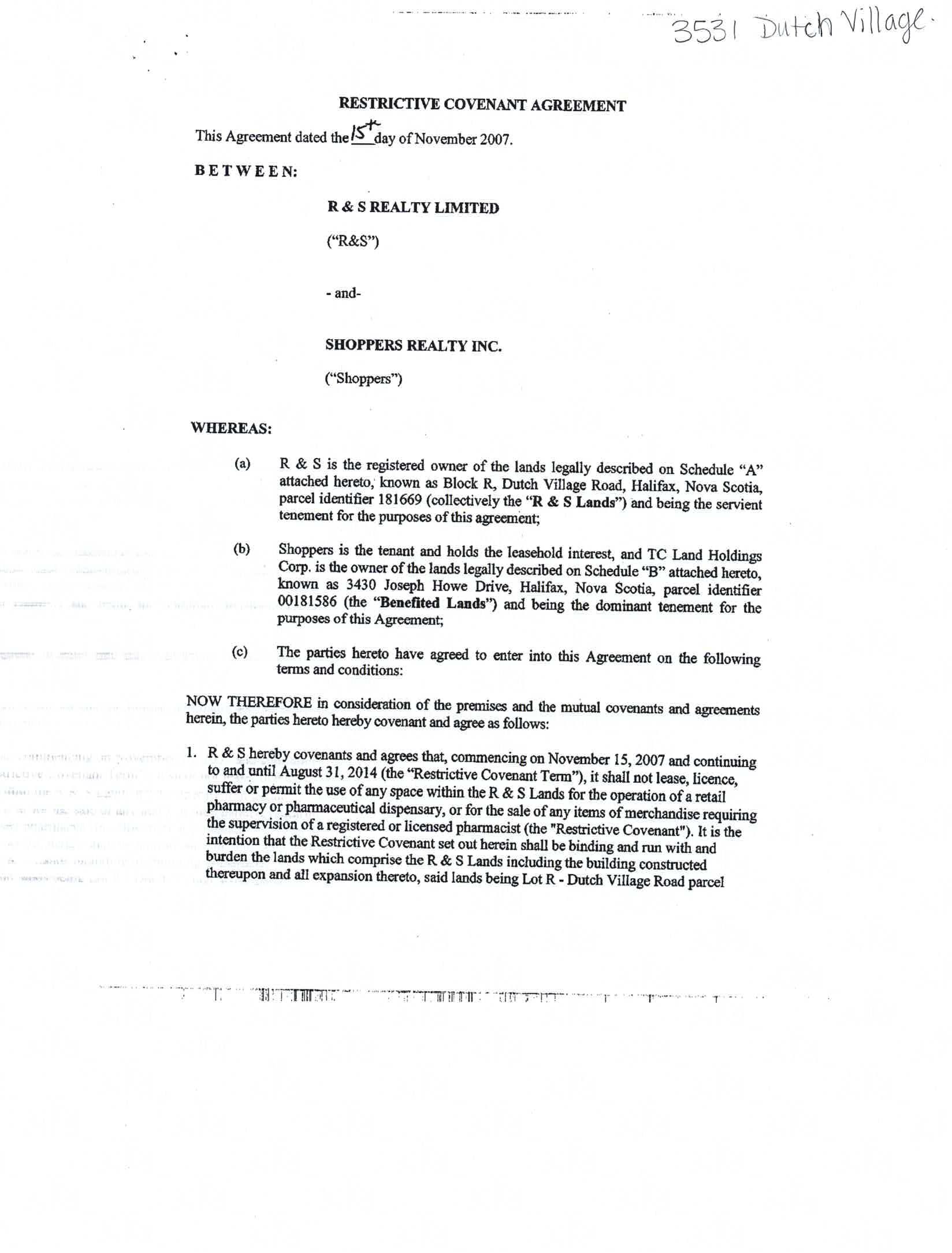
| NS | Halifax | 3531 Dutch Village Rd. | Blocks rentals to a pharmacy business, for 7 years. |
| NS | Halifax | 3440 Joseph Howe Dr. | Shoppers Drug Mart forbids dollar stores, beauty shops and other businesses on plaza. |
| NS | Halifax | 90 Lamont Terrace | Snippet of a covenant with Home Depot (?), blocking any hardware-related stores. |
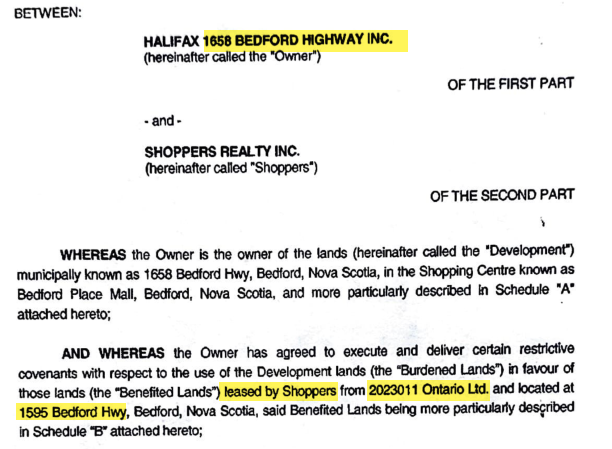
| NS | Bedford | 1658 Bedford Hwy. | A remarkable example of Shoppers, located at 1595 Bedford, reaching beyond their mall to the neighbouring mall across the road. This covenant prevents this 3rd party landlord from renting to a pharmacy for 3 years. |
What are restrictive covenants?
“Restrictive Covenants” are a tool that Canada’s biggest grocers use to block competing groceries from moving in to certain locations. The Competition Bureau is currently investigating the harms that stem from this.
The concept of Restrictive Covenants is long-established in real estate: it is a restriction on the use of land for certain purposes. For example, it could block you from opening a smelly petting zoo on your property. Historically, they were used to keep out members of minority races from neighbourhoods in the USA and in Canada.
Covenants typically “travel with the land” – this means that they bind all future owners of the land. Sometimes in perpetuity. Covenants override a city’s municipal zoning rules.
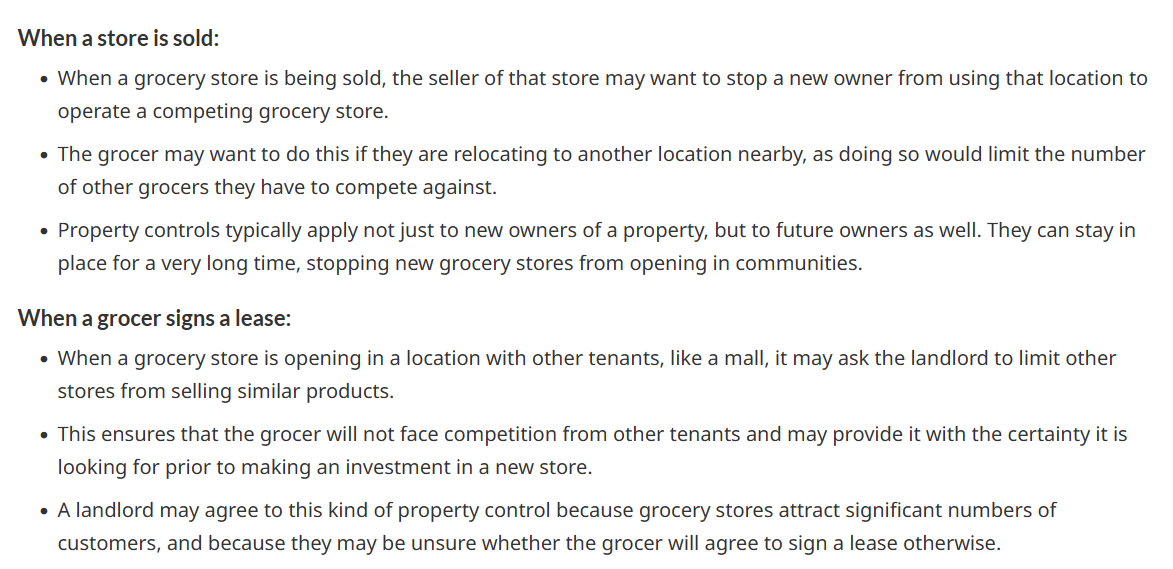
Here is a clear summary of how grocers use covenants to reduce competition, from a 2023 Grocery Market study by the Competition Bureau of Canada:
To learn more about restrictive covenants, I highly recommend SCORCHED EARTH: THE USE OF RESTRICTIVE COVENANTS TO STIFLE COMPETITION by Bruce Ziff and Ken Jiang (published on 2012-10-01 at the Windsor Yearbook of Access to Justice).
They explain why covenants are rarely challenged in practice:
Although it appears that the use of restrictive covenants to inhibit competition is found in a number of commercial realms, there is rarely an incentive on the part of would-be purchasers to challenge the validity of a restriction. Why mount an assault if there are ample alternative business sites?
…
At the same time, a rival business might not wish to invalidate the restriction even ignoring the time, expense and uncertainty surrounding that kind of legal action. After all, that firm might want to free-ride on the restriction by locating near to the restricted parcel, since it is likely that a competitor will not try to set up shop on the restricted site.
List of grocery covenants
Edmonton, AB: 5120 122 St NW, Lansdowne Centre (T6H 3S3)
This is a restrictive covenant between Safeway and Three M Investments, from December 2008.
The covenant forbids renting out the premises to businesses that sell food for off-premises consumption (grocery stores):

My understanding is that this covenant applies forever. Until Safeway says in writing that it is lifted:

The property was operating as an IGA back in 2007:

But as of at least between 2009-2012, there has been no tenant there. In 2014 Google streetview shows “Find” – a furniture/thrift store – moving in.
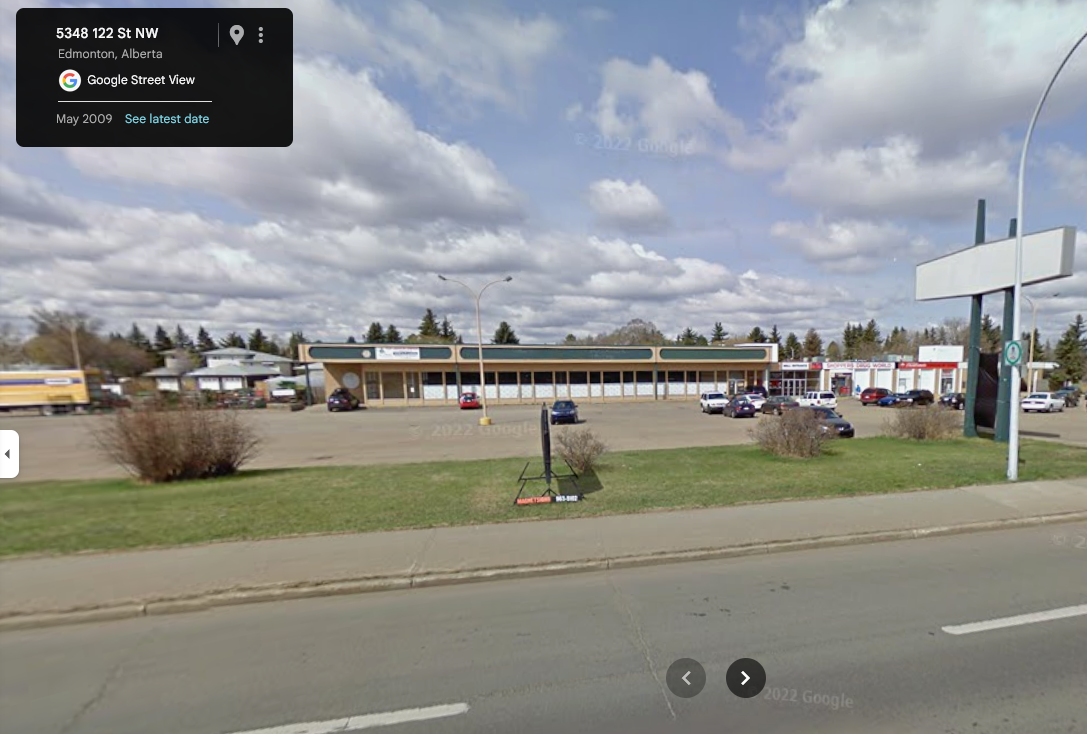
Edmonton City Counsillor Michael Janz has called out this property as an example of the negative effect of restrictive grocery covenants. Counsillor Janz says that residents have to drive an extra 2km to the nearest grocery store.
And here is a restrictive covenant on an adjacent/related parcel, also from 2008 – but between Safeway and Alldritt Development Limited.

Edmonton, AB: 14246 96 Ave NW (T5N 4B2)
This is the same block of properties as “Crestwood Centre” at 9604 142 St NW.
This is a covenant that was connected to a year 2000 lease with Great Pacific Industries (“Save-on-Foods”). It only lasted as long as the tenancy – so it didn’t “carry with the land” for an unreasonable span. While it was in force it forbid other tenants in the plaza from selling foods.

The covenant also includes a restriction on cinemas, spas and gyms, under the rationale that they place undue burden on parking facilities. They also block adult book stores under the same logic… which doesn’t seem consistent.

This property has a LINC identifier of 0027588798, and the restrictive covenant is registered as document 002193697.
Edmonton, AB: 10105 137 Ave. (T5E 1Y8)
In this document Sobeys, the owner of the “dominant lands” on the Northwest corner at 97 St. NW and 137 Ave. NW, places a restrictive covenant on the owners of the land on the Southwest corner:

The “subservient lands” on the Southwest corner are currently a Ford dealership. The owner is prevented from renting the premises to a supermarket for a whopping 60 years. This contract was signed in 2014, so it’ll be 2074 before a grocery store can even think of moving in!

This parcel has a LINC number of 0031255351
A previous restrictive covenant from 2005 indicates that there used to be a Sobeys (“Garden Market”) on the site of the Ford dealership. In the older covenant a diagonal slice of the property is forever blocked from becoming a grocery:


Edmonton, AB: 6633 118 Ave NW (T5B 0P1)
This is a large lot that stayed unused for at least 12 years when Safeway left and nuked it with a restrictive covenant. Eventually, a Long & McQuade musical instrument store moved in. Take a lookat this series of Google Streetview pictures of the location:

Locals have been commenting about that property on Reddit. It is a prime example of the damaging nature of covenants: in 2005, Good Earth Produce attempted to move into this location1 but Safeway blocked the move. Safeway would only permit Good Earth to move in if they bought 80% of their produce. After several rounds of negotiations, Good Earth left the Highlands neighbourhood and moved to Clareview instead.
The covenant on this one is interesting because it prevents a grocery/food store on the property for as long as 3 other Safeway (Sobeys) locations remain functioning:


Are those 3 “dominant tenants” still functioning as grocers in 2026?
8118 118 Ave. NW is currently a FreshCo. (a brand of Sobeys – which took over Safeway Canada)
At Manning Crossing in Edmonton, there is a Safeway:
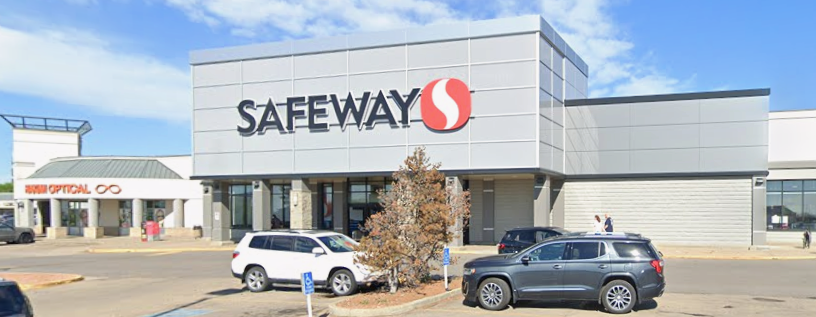
3210 118 Ave NW ceased being a grocery, and is now an “Amazone Playzone”. I wouldn’t be surprised if Safeway also put a restrictive covenant on that property when they left.
The property’s LINC number is 0014901714
Vancouver, BC: 1650 Davie St.
This Vancouver city policy report from 1998 (backup) describes the location as: 1650 Davie Street is a former SuperValu site, currently occupied by London Drugs. In 1996, Loblaw’s (SuperValu) agreed to give up their lease provided the site’s owner agreed to a covenant restricting the use of the property for the sale of food. This covenant runs with the leases of the nearby stores it is meant to benefit (1030 Denman Street and 1255 Davie Street) and is automatically renewed with renewal of those leases.
The 1030 Denman location has a NoFrills (as of March 2026) and 1255 Davie has a “Your Independent Grocer” – both Loblaws’ brands. So the covenant is very much still active.
Here is the restriction on the % of floor space that can be used for groceries:

And the condition that ties this to the other leases, with those relevant “dominant lands” parcel identifiers:


This document is from the parcel with PID 029-872-812 and here is the Title record for it as of March 2026.
Halifax
The below restrictive covenants for Halifax were captured in 2019 and may not be valid at this time. These covenants were generously provided by Jenna Khoury-Hanna.
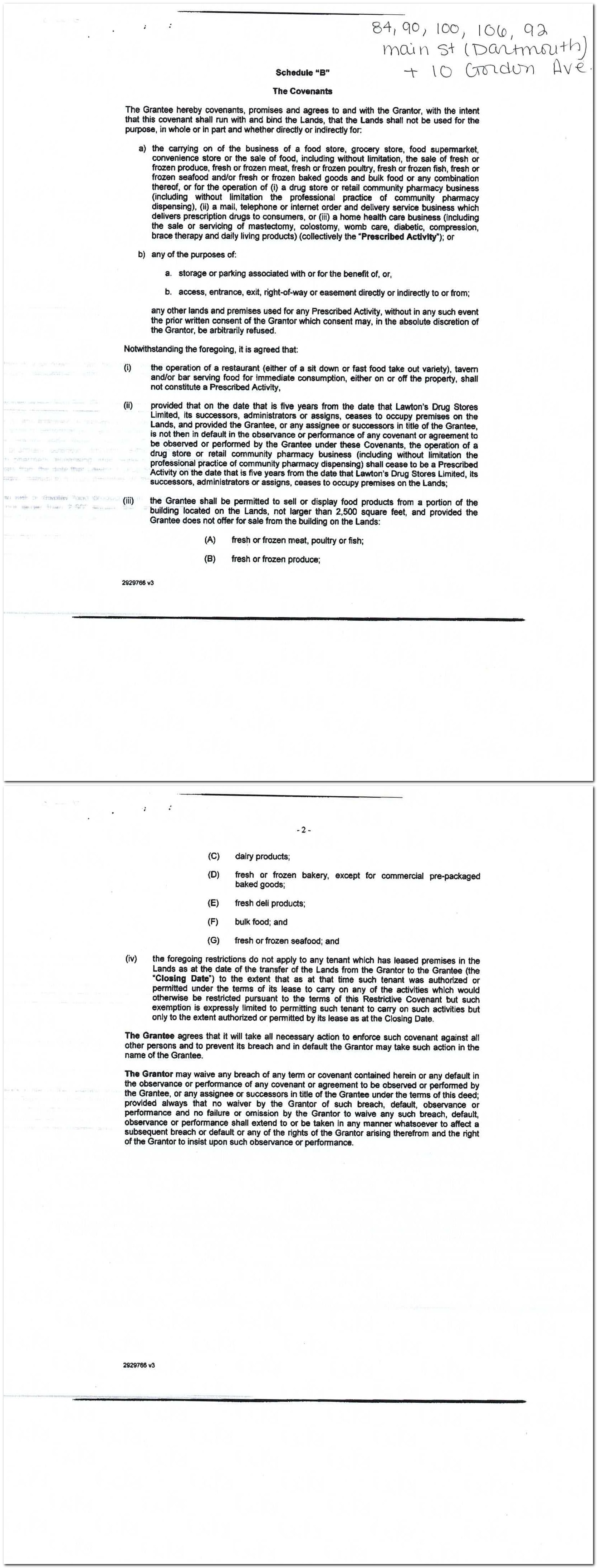
84 Main St. (Dartmouth) & 10 Gordon Ave.
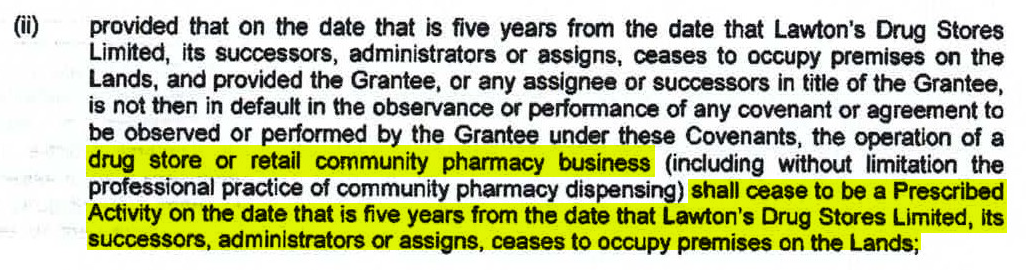
In this one, Lawton’s Drug Stores Limited blocks the landlord from allowing the land to be used as a grocery or a pharmacy. Only 5 years after Lawton’s leaves the strip mall, will the landlord be allowed to rent to another drugstore.
Notice that the grocery restriction is never lifted – the land can never be rented to a grocer!
210 Wyse Rd. (Dartmouth)
This one is a blanket 20 year block on using the land for a grocery or a drugstore. I believe this covenant was put in place by Sobeys.


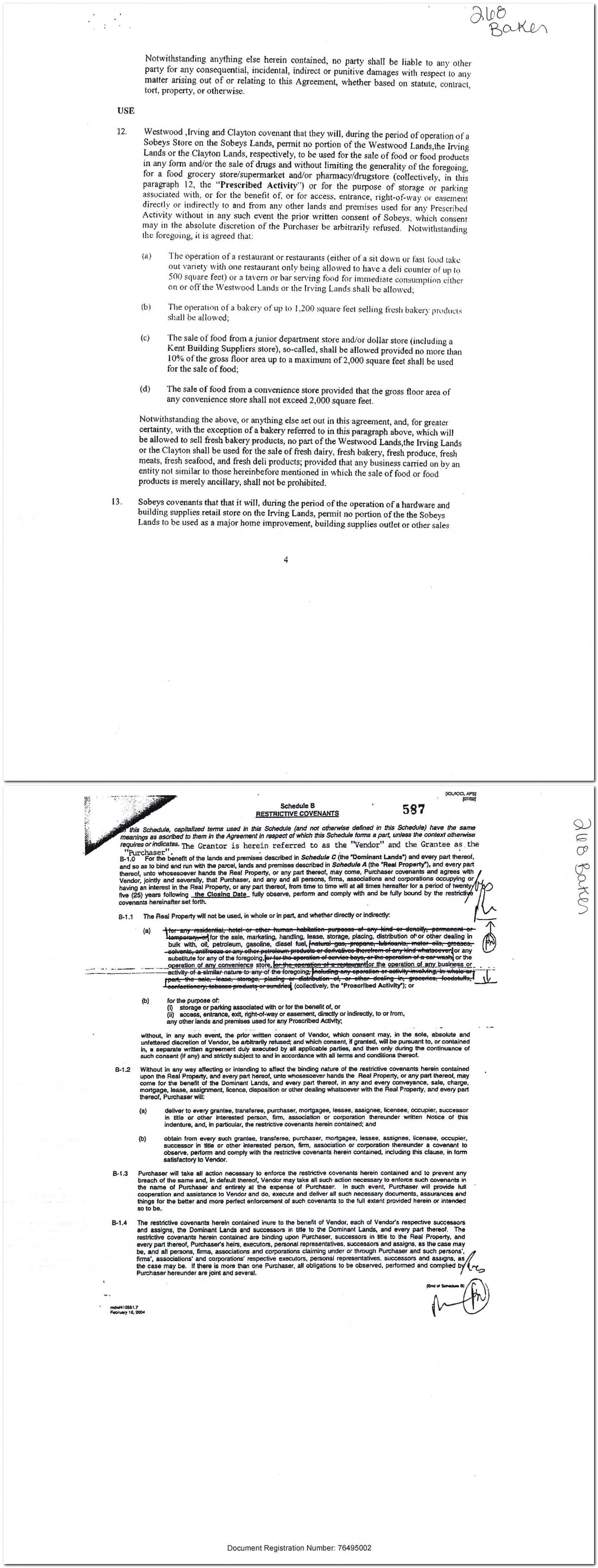
268 Baker Dr. (Dartmouth)
This is a Sobeys contract preventing the sale of groceries or drugs on the plaza. The covenant refers to Irving, Westwood and Clayton lands. I did not purchase the entirety of this document, but I wonder if the mention of these 3 parties means that the covenant covers a bigger area than just the plaza.

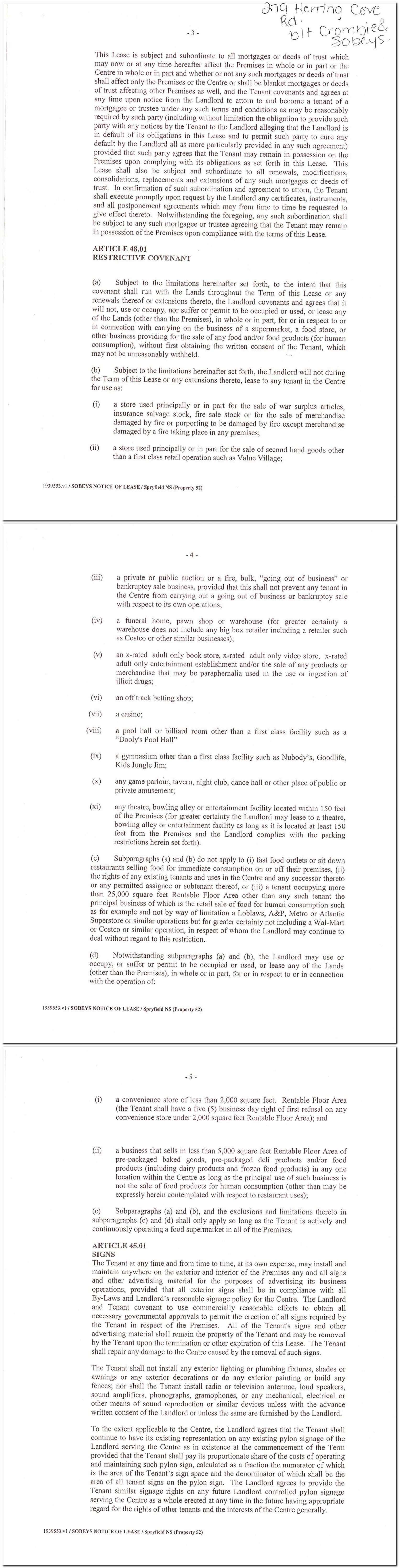
279 Herring Cove Rd.
This is a Sobey’s covenant, preventing the property owners from leasing to another grocery during the duration of Sobey’s tenancy (pretty reasonable). What makes this document interesting is that it blocks a variety of other businesses from moving in nearby. Businesses like “non first-class gyms”.
It’s interesting to see how these private agreements stifle the creation of new businesses in Canada – in this case, favouring incumbent gyms over upstarts.


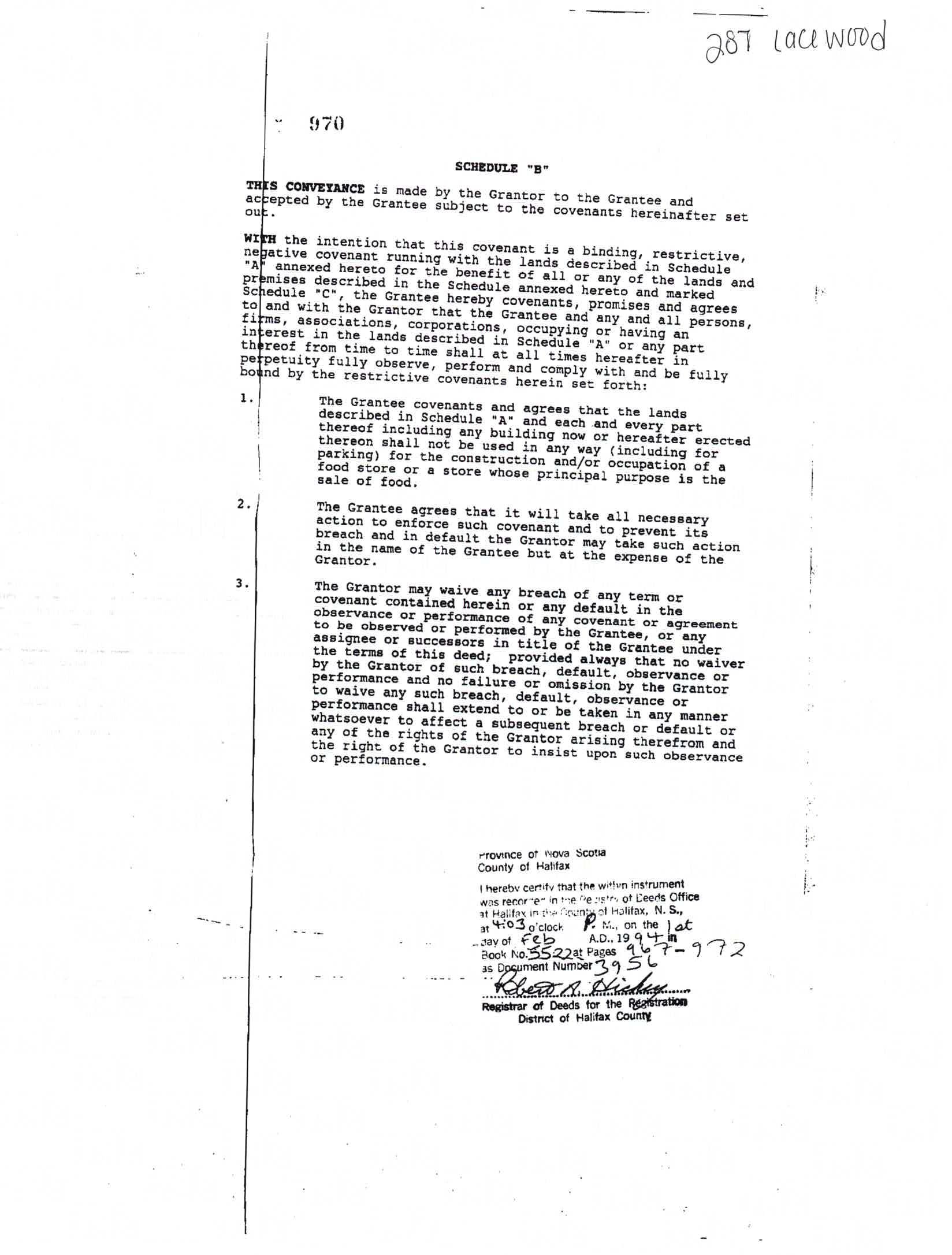
287 Lacewood Dr.
There is a 1990 covenant between Clayton and “Food City” on this property. In this deal, Clayton agrees to not permit a grocery to operate on their lands – which are adjacent to the actual Food City lands. In this way, the grocer is expanding their sphere of control over nearby properties.
This is a perpetual agreement, running with the land forever.

There’s an additional covenant, of which I only have a snippet:

There’s a 3rd covenant on this property from 2008. For the duration of Sobey’s lease (and any extensions), it blocks any food businesses (other than fast food/sit-down restaurants). It also restricts any secondhand business, gym or billiard facility to “first class” facilities – in this way, a big grocer is blocking start-up businesses in a variety of fields from rending at this property.
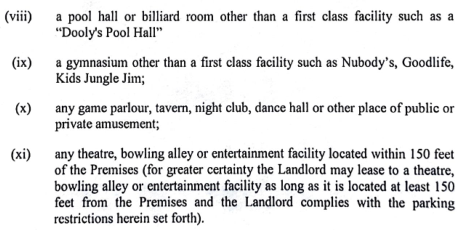
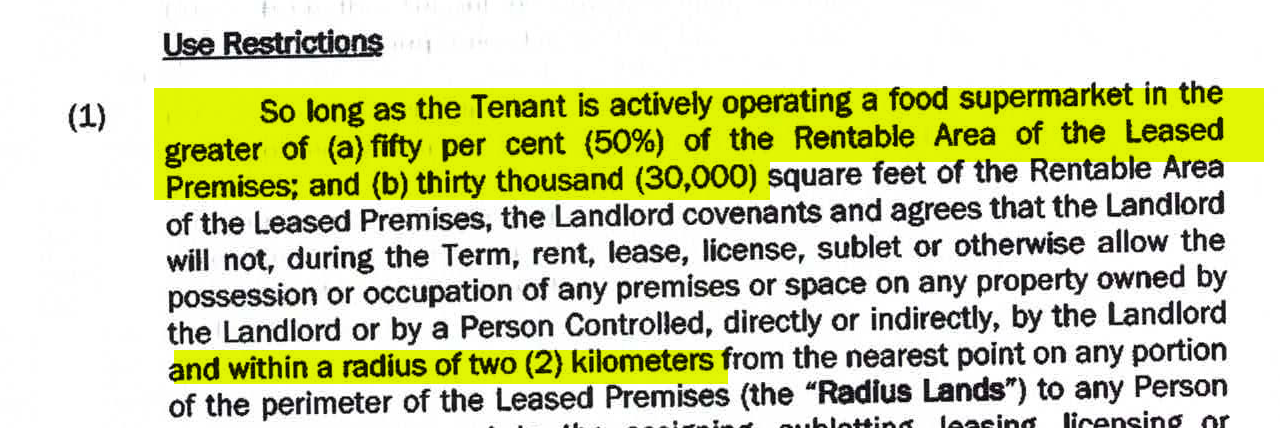
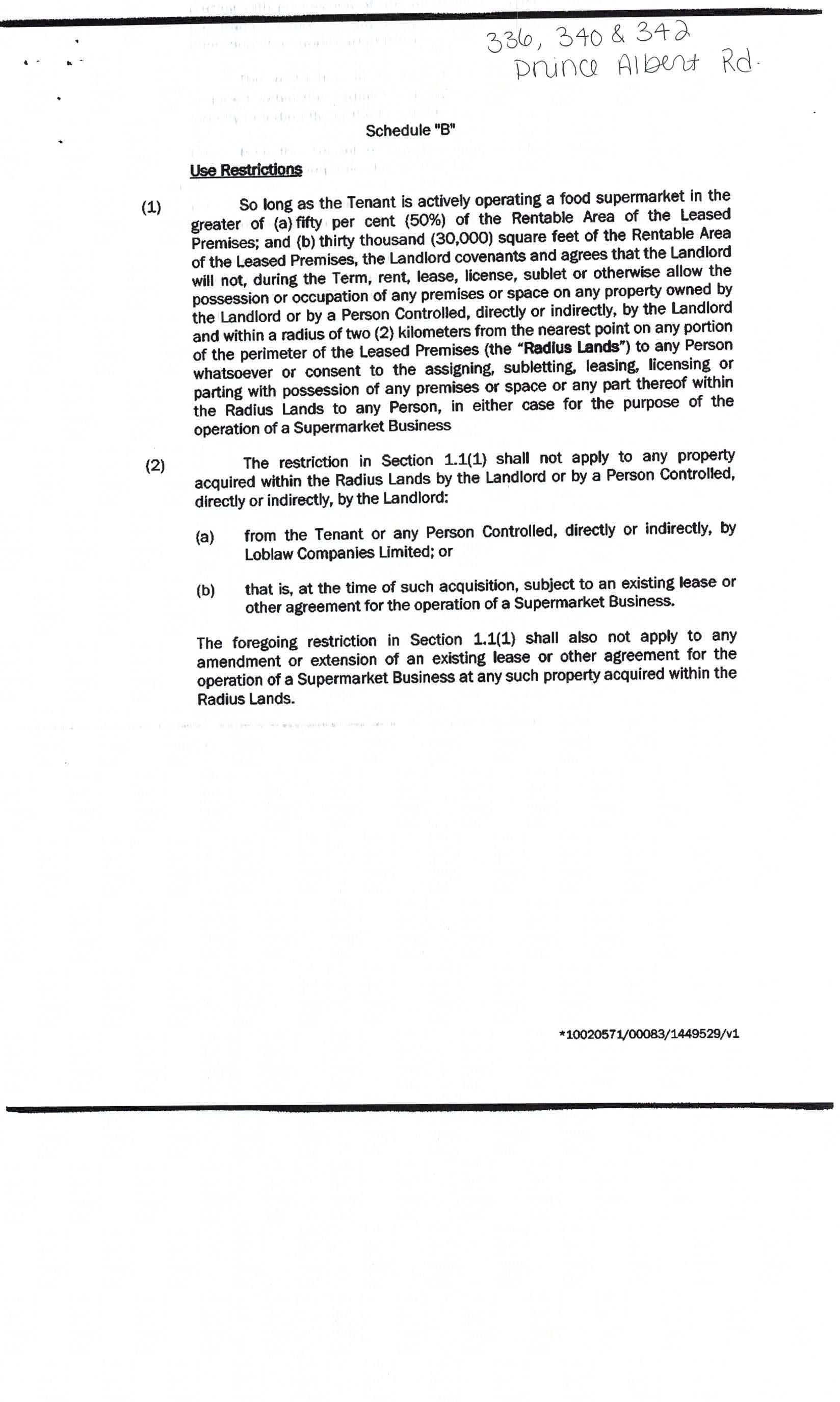
9 Braemar / 336 Prince Albert Rd. (Dartmouth)
In this covenant, Atlantic Superstore restricts the landlord from renting to another supermarket for the duration of the lease (reasonable), but also blocks renting to another supermarket on any properties the landlord owns in a 2km radius (unreasonable).
This is one of the deals between Loblaws and CP REIT.
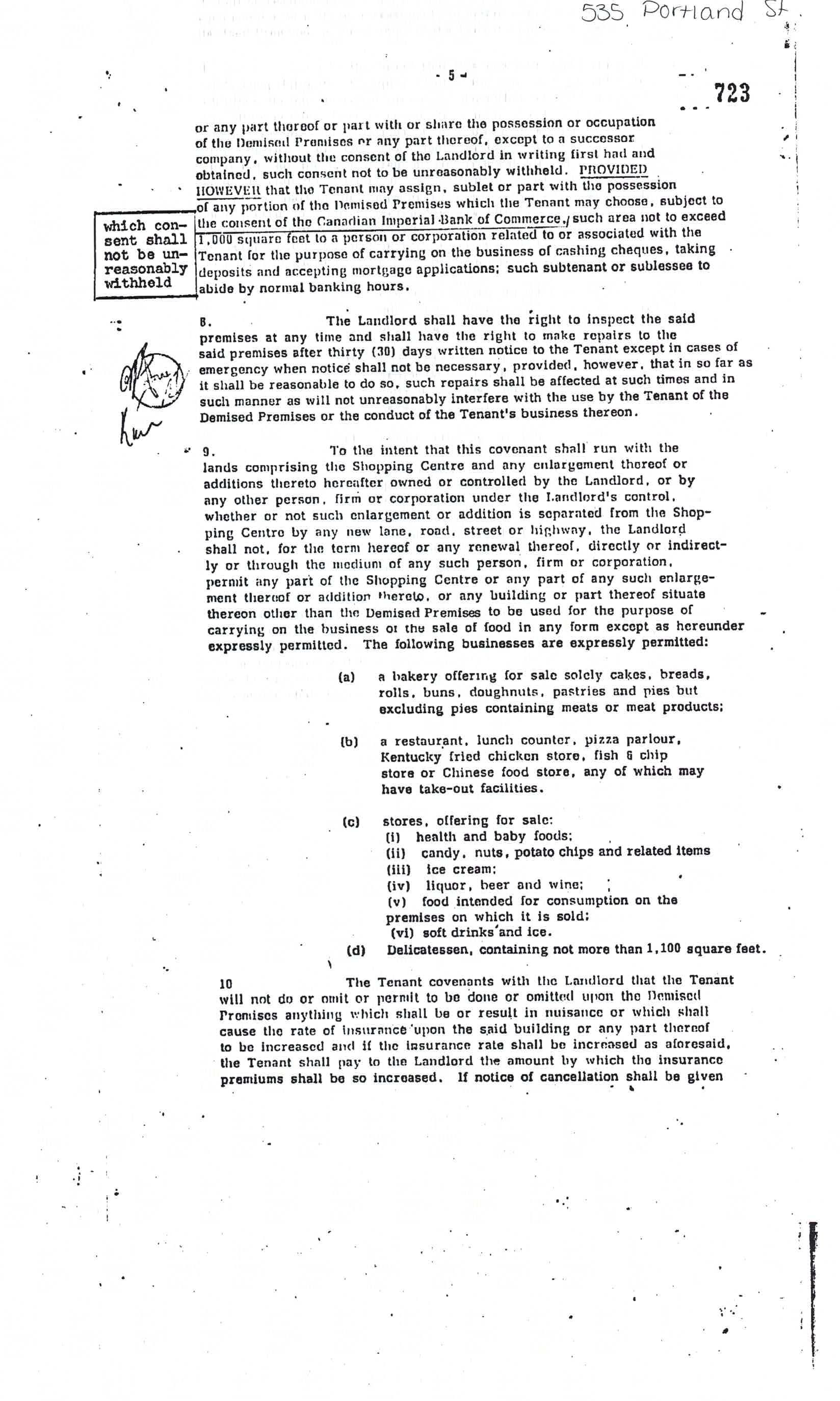
535 Portland St.
This covenant has a grocery restriction, but I think it might be restricted to the term of the current lease.
5240 Highway 7
This is a Loblaws & CP REIT agreement. Contains a 5Km “radius lands” restriction, and blocks dollar stores from promoting national brands as a loss leader.

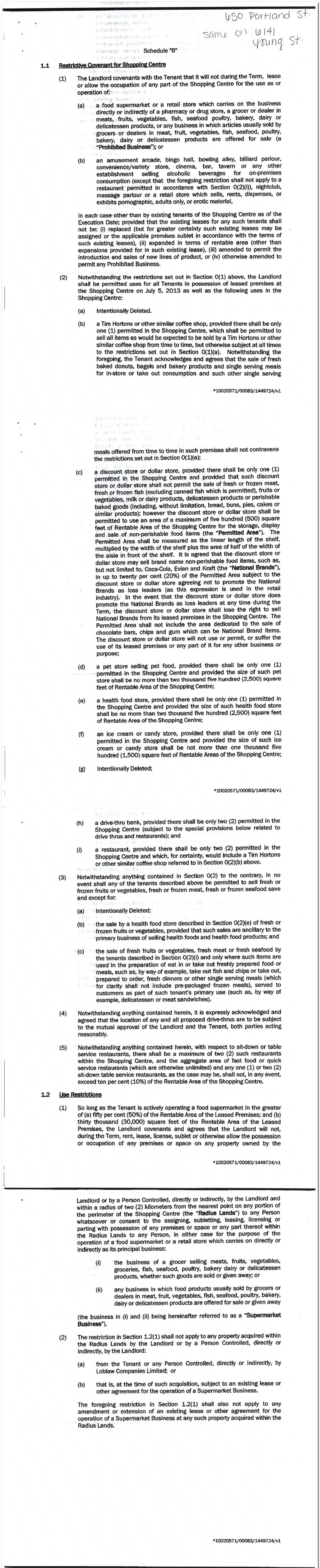
650 Portland St. / 6141 Young St.
Both 650 Portland and 6141 Young are owned by Choice Properties REIT, and this covenant is an example of the kind of deal Loblaws signs with itself when it rents in a CP REIT mall.
The contract with Loblaws specifies in minute detail which kind of tenants can be in the mall (no more than 1 dollar store, 1 cafe, 1 pet store), forbids awful stuff like cinemas or bowling alleys. It also includes a 2km radius condition forbidding CP REIT from renting to another grocery store at their other properties.
This is a fantastic example of the fiction inherent in REITs – they’re supposedly neutral land-holding vehicles. In reality, these covenants favour Loblaws and shape the operations of the mall around this tenant. CP REIT is absolutely not independent of Loblaws when they’re allowing these sweetheart deals.
745 Sackville Dr.
Another deal between Weston-owned Loblaws and a Weston-owned CP REIT mall, as above.

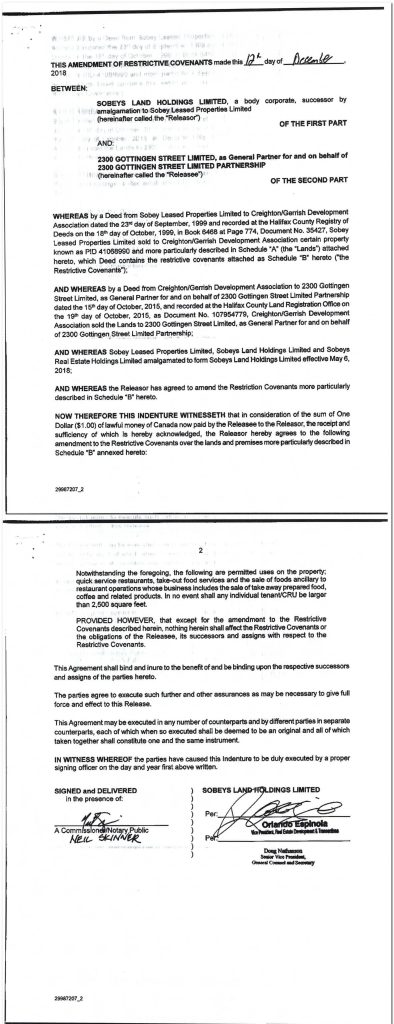
2300 Gottingen St.
The restrictive covenants in the Gottingen neighbourhood are creating a “food desert” and the CBC has covered the issue in 2024.
This covenant is an amendment to a previous covenant – I believe it is a refresher that updates the parcel’s record through sales to subsequent owners. It benefits Sobeys by blocking any grocery store, convenience store or pharmacy on the location. Many thanks to Matt Vaughan for acquiring “Schedule B” of this document.
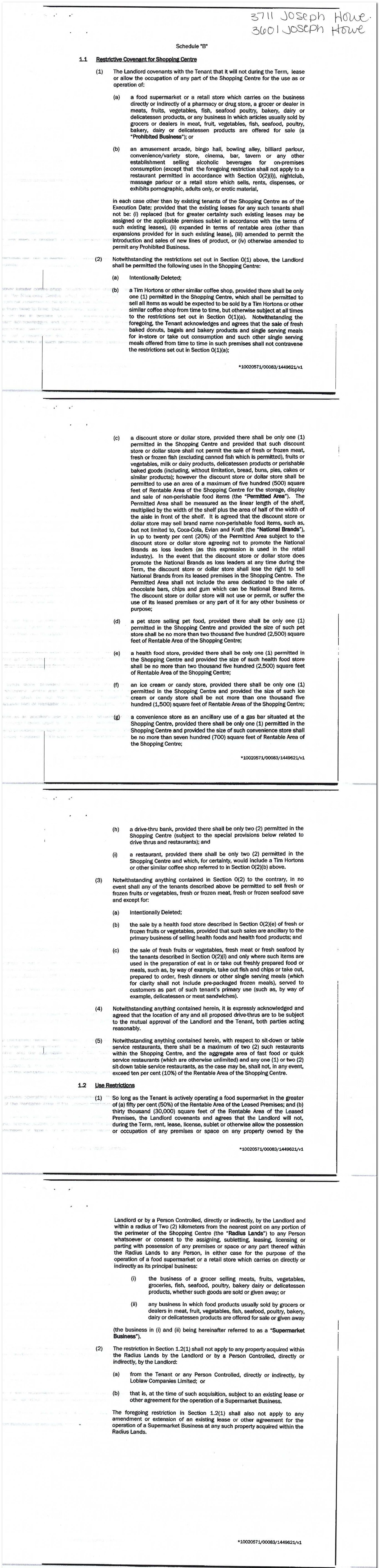
3711 Joseph Howe Dr.
Another example of a Loblaws covenant with a CP REIT-owned mall.
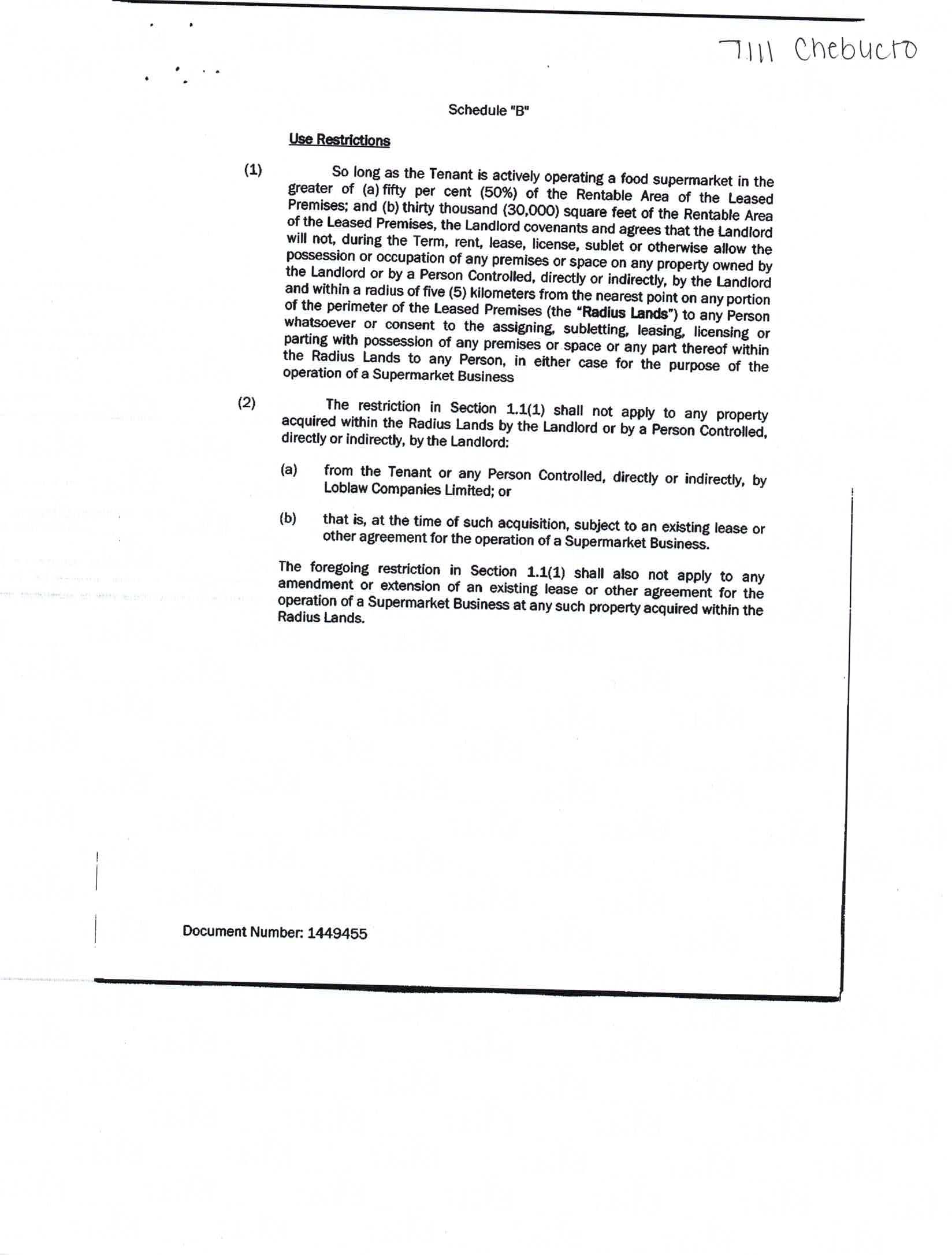
7111 Chebucto Rd.
A small snippet deal between Loblaws and CP REIT on a strip mall. This one is different from Loblaws’s standard covenants because it prevents CP REIT from renting to another grocer in a 5 Kilometre radius (instead of a 3k radius).
Sauble Beach, ON: 605 Main St.
A rare example of Loblaws (Valu-Mart) leaving a place* and placing a covenant on the land behind them. All types of grocery businesses and garden centres are blocked from the land for 25 years (until 2034).
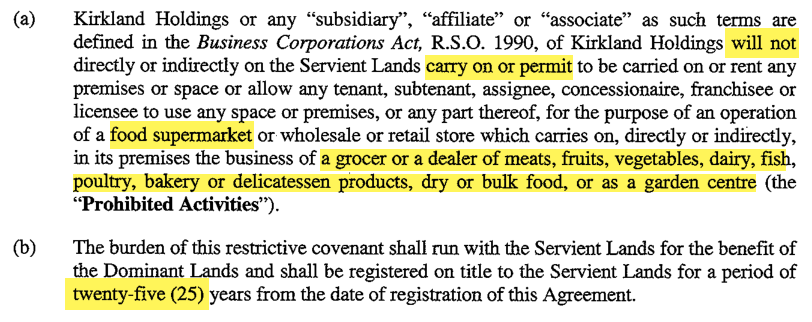
According to a local:
Sauble Beach had a main corner building in no-mans land up until recently due to Loblaws’ covenant from the old grocery store there. It is now opening as a dollar store, but there are still restrictions on what food items can be sold. It was the reason that a previous few sales had fallen through, I’m told.
Source, July 2026
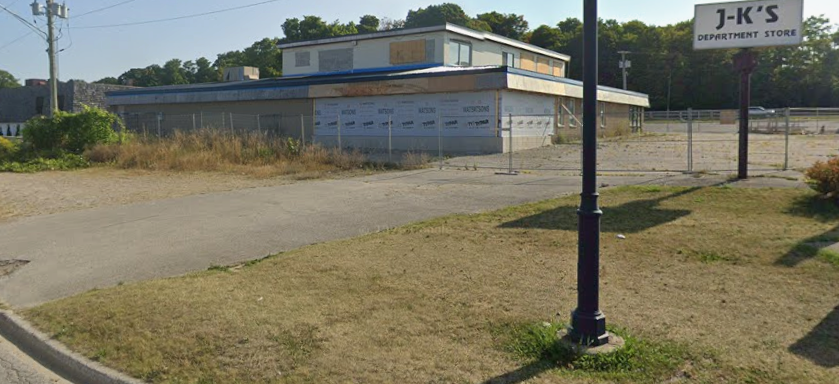
The property sat empty from at least 2021 (when a “for sale” sign appeared) to 2026 when Save Mart opened on the location.
* Judging by how extremely difficult it’s been for me to find instances where a grocer has left a location within the last ~15 years, I believe that the grocery business is incredibly profitable. These stores just do not go under.
Toronto, ON: 985 Woodbine Ave.
Lease between Valu-Mart (Loblaws) and CP REIT (Loblaws). These are not independent entities and are both controlled by the Westons.
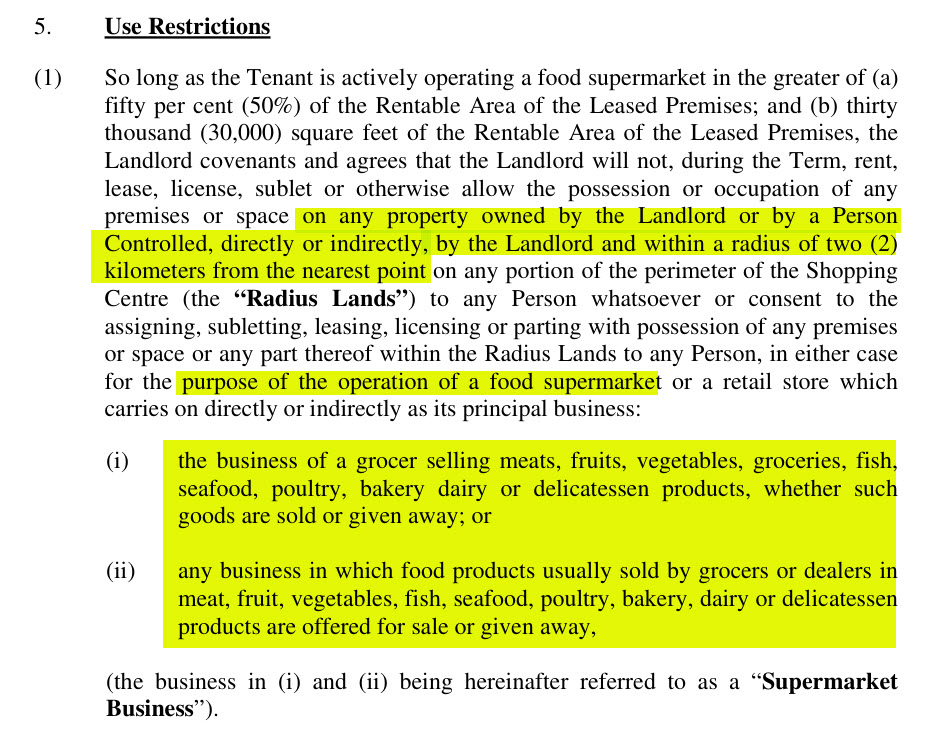
This is a Lease agreement preventing anyone from selling groceries on the territory of a shopping block while the Valu-Mart is in operation.
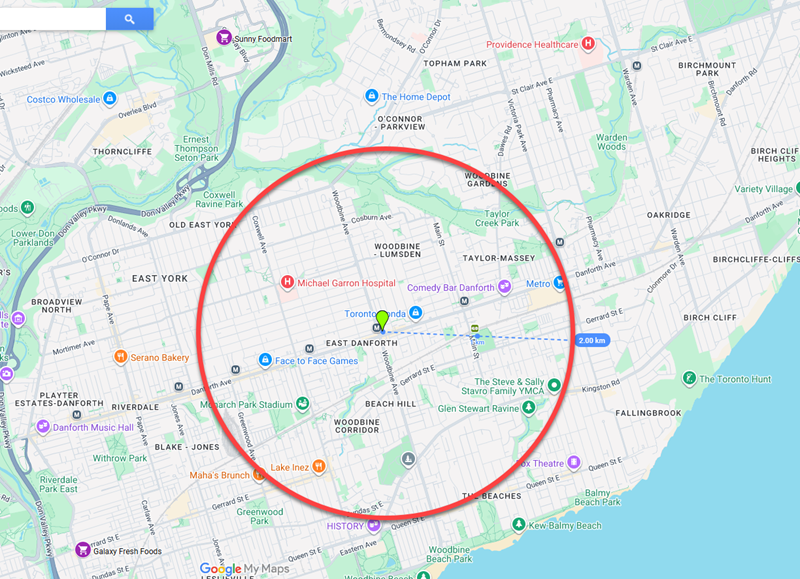
What’s interesting is that this one lease also blocks the Landlord from leasing property to any other grocer within a 2 Kilometre radius of the shopping centre. The landlord in this case is CP REIT – Canada’s largest real estate investment trust, and you can bet that they own land nearby*.
* Actually, I will owe you an update: CP REIT discloses all their properties, and I will check whether any major ones are within that radius. The adjoining ones on Danforth Ave. are definitely owned by CP REIT.
The lease spells out what type of tenants, and how many of them are allowed on the plaza. It also has a clause that forbids a dollar store like Dollarama from promoting any “loss leaders”, a direct way of setting a “price floor” on National Brand products.
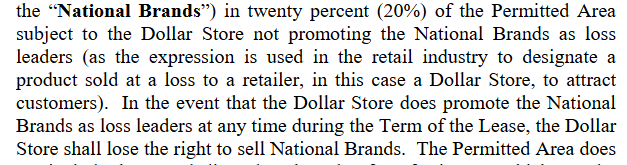
The restrictions are only in place as long as Loblaws uses at least 50% of their tenanted area as a grocery.
Here is a visualization of the “no grocery leasing” area that’s covered. This is a big urban swath of land. It covers the distance of 5 subway stations.
And, if you think the impact from these radius restrictions are theoretical: here is the real-life story of covenants creating difficulties for Iqbal’s Halal Foods in Toronto.
Port Elgin, ON: 216 Goderich St.
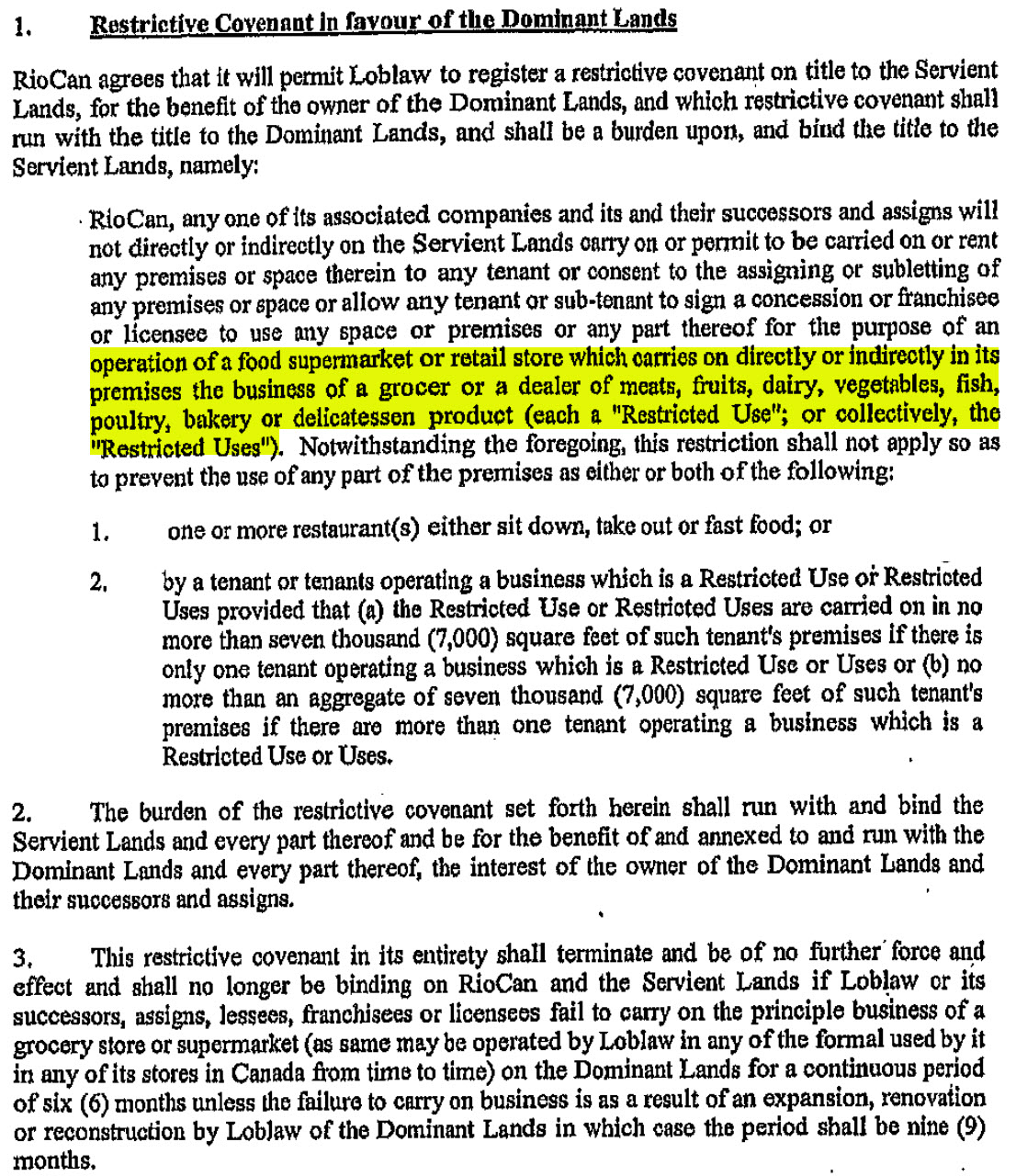
This is a 2004 deal between Loblaws and RioCan to prevent the Giant Tiger in Port Elgin from selling food indefinitely as long as Loblaws’ “Independent Grocer” in the town of Saugeen Shores is operating.
This deal is meant to restrict
Subservient lands
This location can’t sell groceries of fresh food as long as the “domainant lands” are operating as a grocer. I believe it is PIN 33273-0545, 216 Goderich St. in Port Elgin. This location currently has a Giant Tiger on it.
Dominant Lands
PIN 33268-0808, which is the Your Independent Grocer on 1244 Goderich St. in Saugeen Shores.
The highlighted passage shows the kinds of activities that are restricted. Section 2 illustrates the power of a Restrictive Covenant to bind future owners of the land. The restriction bind 216 Goderich for as long as one of the Loblaws’ groceries is operating on the property:
Question for readers who are Lawyers: what does section 3 mean? Does the covenant expire if Loblaws stops operating for 6 months in the future, or does it expire only if Loblaws fails to operate a store for just the initial 6 month period after the covenant is added?
Waterloo, ON: 600 Laurelwood Dr.
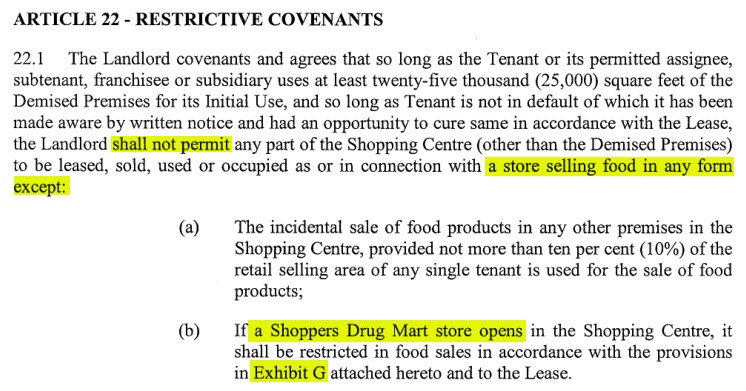
This is a lease agreement for a shopping plaza, where Metro put in a “Food Basics” grocery. It forbids other tenants from selling foods while the tenancy is active:
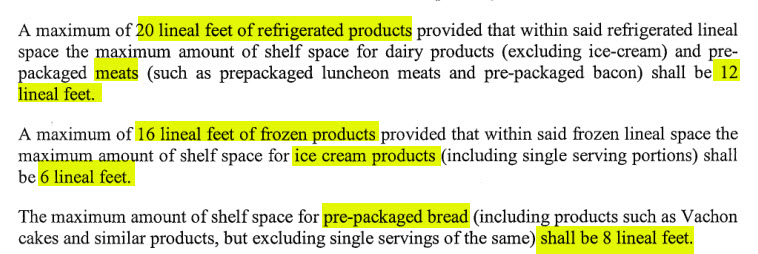
What’s interesting is that the lease outlines in minute detail what foods, and how much of each, a potential Shoppers Drug Mart is allowed to sell. There are strict limits on how much bread can be sold. In what other context is one business allowed to control another business’ operations in such detail? Is this what you would call free-market competition?
Picton, ON: 23 George Wright Blvd.
This is a 20-year lease agreement between Sobeys and “Picton Properties Inc.”
In this shopping plaza, none of the other tenants are allowed to sell food or non-alcoholic beverages without Sobey’s permission. There is also a 3 Kilometre radius restriction placed on Picton Properties Inc. – they can’t rent their other land to a grocer.
Dear Lawyer readers: I’m not clear if this covenant runs with the land independently of the lease. Could you please weigh in?
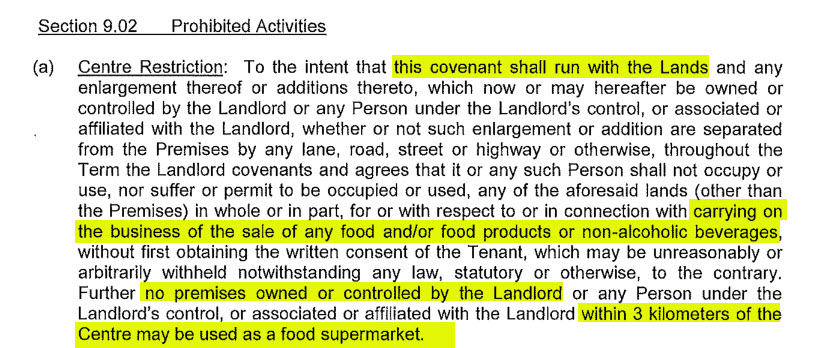
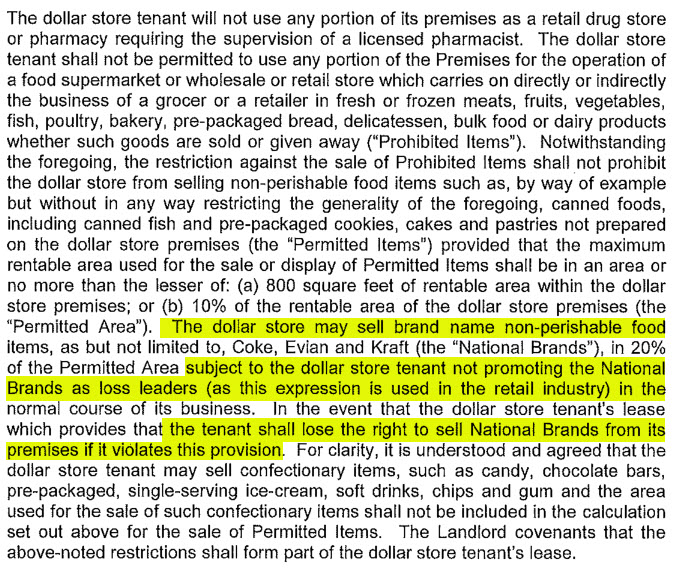
This lease has a whopper of a clause where Sobeys permits any Dollar Store tenants to sell name-brand non-perishables. But only if they never undercut Sobey’s price (ie. use them as a “loss leader”). If this happens, the landlord is obligated to prevent selling National Brand goods.
Of course, the intent of all this is to keep prices high for consumers. It has a similar setup to the price-fixing scheme that Walmart and Pepsi executed in the USA and it may be an illegal act called Price Maintenance.
Other interesting covenants
Caledon, ON: 12570 Kennedy Rd.
This document contains an example of a restrictive covenant on pharmacies and a variety of other businesses.
It is part of a bankruptcy procedure and deals with removing restrictive covenants that prevent running a pharmacy in a commercial plaza. It looks like the covenants were extended from one property to the neighbouring property, owned by the same people (similar to the “restricted radius” concept in some of the grocery covenants). And the bankruptcy administrator wanted to remove that restriction.
One of the key parties behind this covenant – 6876285 Canada Limited – was actually Shoppers Drug Mart.
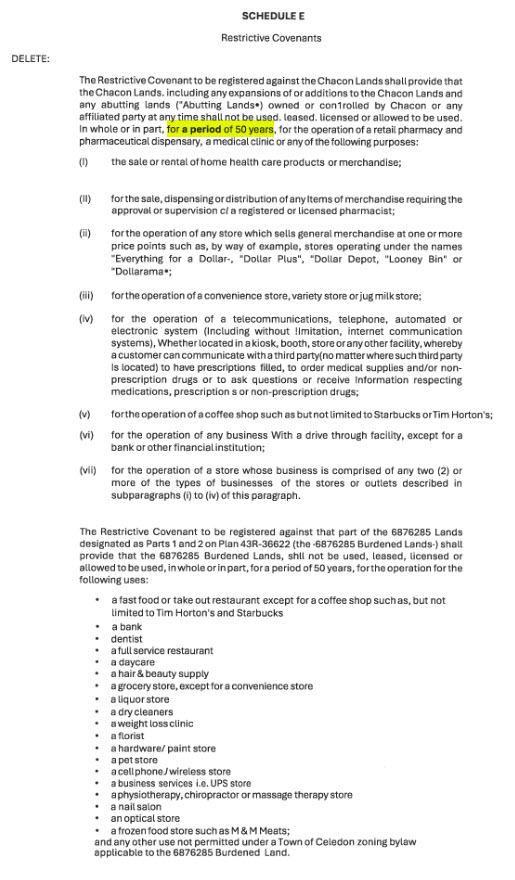
See pages 257 and 258 for the covenant detail.
Cranbrook, BC: 1100 Victoria Ave. N.
Canadian Tire blocking just about any type of business for 20 years, from September 2020. See you in 2040!
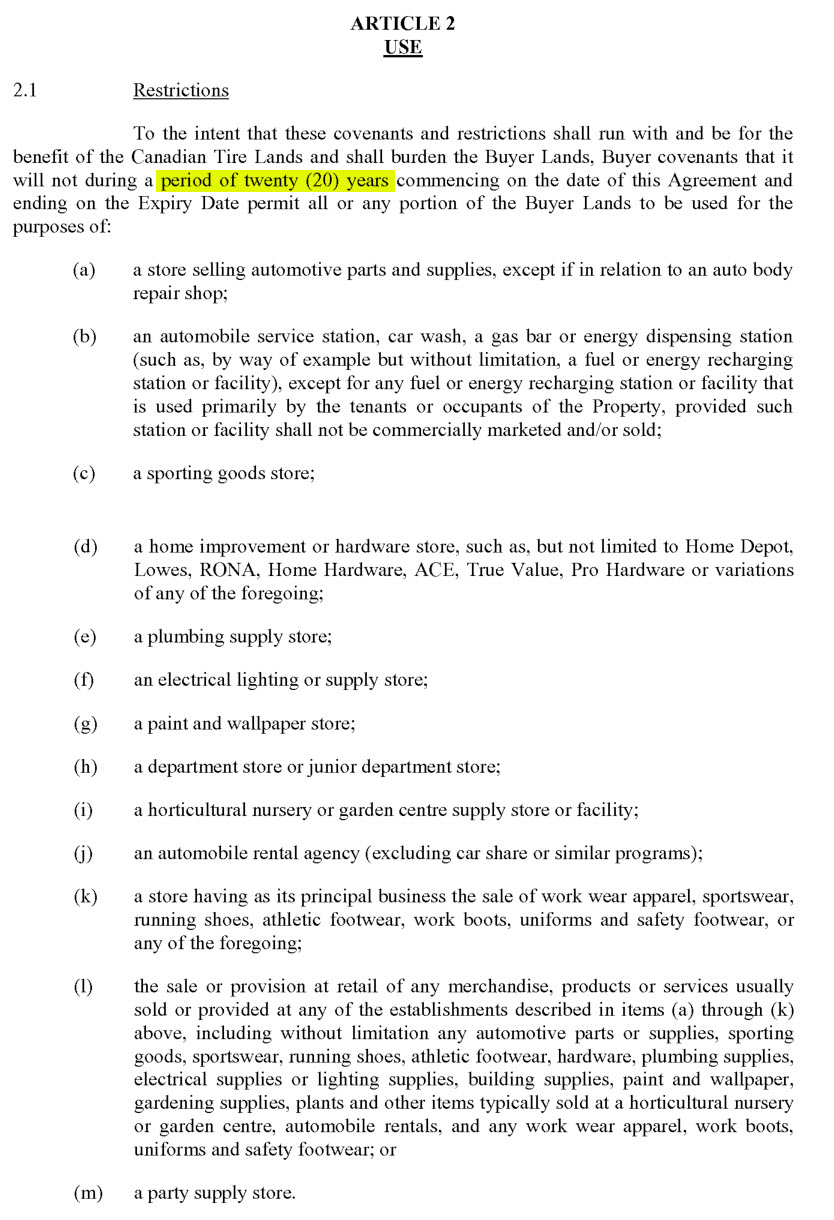
Nothing has been operating at that location from 2018-2026 according to streetview.
Halifax, NS: 3531 Dutch Village Rd. (Shoppers)
This one is a limited 7-year covenant that prevents the landlord from renting to another pharmacy business.

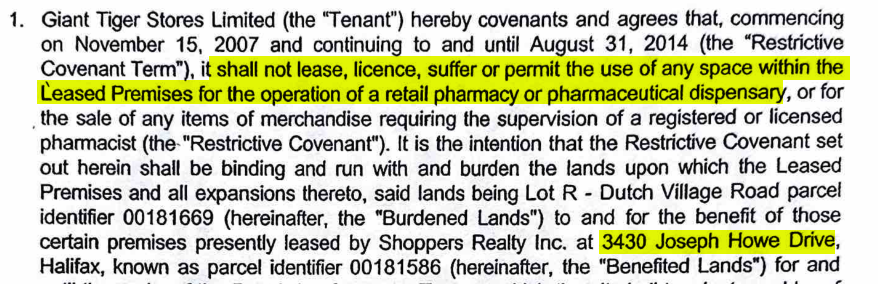
The above covenant is for the benefit of the Shoppers Drug Mart at 3430 Joseph Howe Dr. There is an additional restriction in a lease with Giant Tiger, forbidding it from ever operating a pharmacy – in favour of that same Shoppers location.
Halifax, NS: 3440 Joseph Howe Dr. (Shoppers)
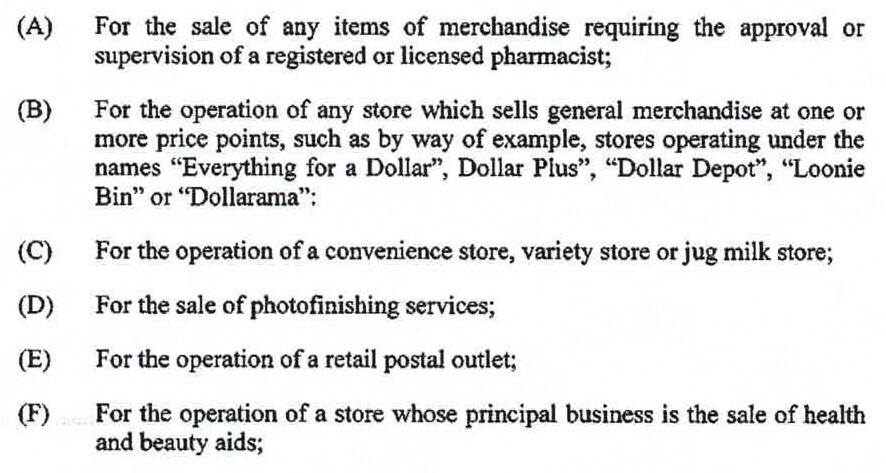
This is part of the same property as the above 3531 Dutch Village Rd. location. This is a covenant with Shoppers which restricts what kinds of other tenants the landlord can rent to for the duration of the lease. The full list of forbidden businesses is extreme – dollar stores, photo shops, postal outlets and beauty shops are just some of the businesses that Shoppers won’t tolerate on the plaza.
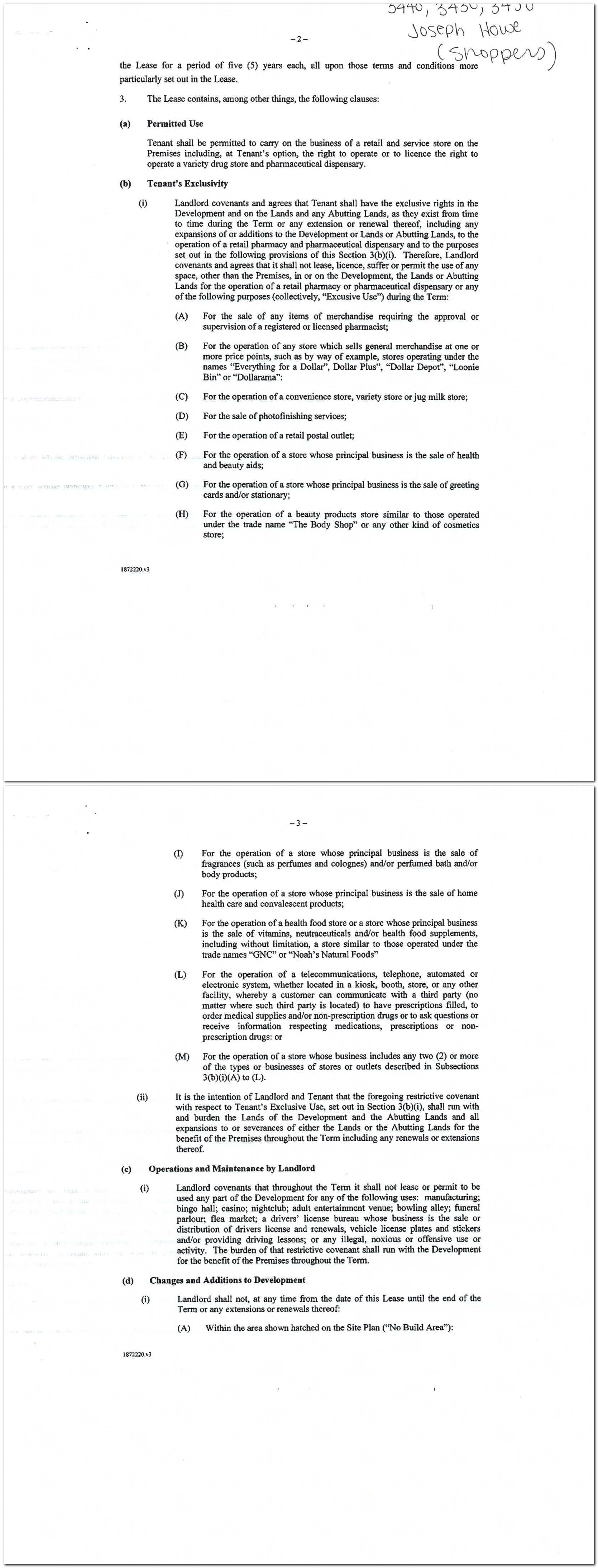
The set of covenants that covers the entire property and Giant Tiger shows you that the landlord is very serious when it comes to enforcing Shoppers’ interests.
90 Lamont Terrace
I only have a snippet for this one – a covenant from 2006, potentially with Home Deopt, blocking the use of the property for any hardware-related business. I believe that it was signed upon HD leaving the location, as there is a Walmart at that address now. The duration of the covenant is 10 years.
1658 Bedford Hwy
A covenant that binds the owners of the building at 1658 from 2012 to 2015, in favour of the Shoppers Drug Mart location across the road in Sunnyside Mall. Shoppers is renting from a completely different landlord.
The owners of the pink mall are promising not to rent to any pharmacies, in favour of Shoppers which is located in the green mall:
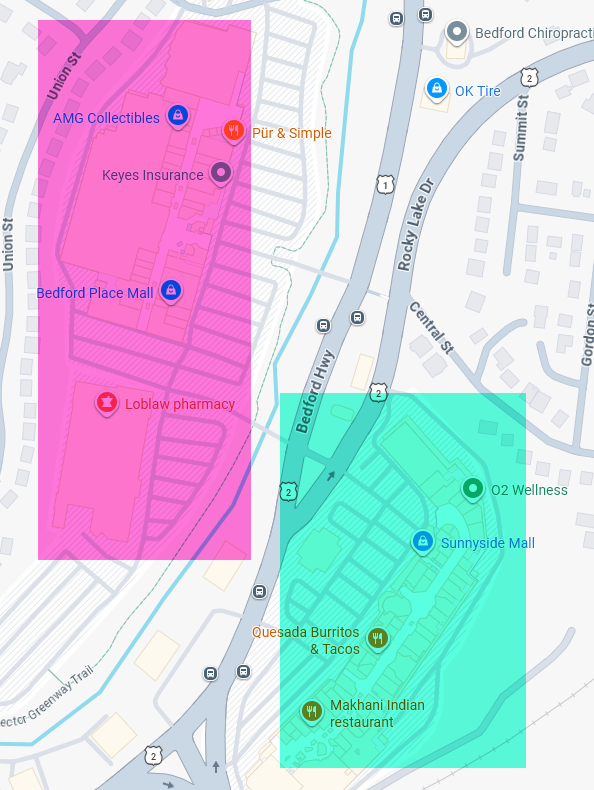
This is a remarkable example of Shoppers using covenants to control the economic environment around their location – going beyond their immediate landlord, and binding surrounding landlords through separate agreements.
Choice Properties REIT
A REIT is a special structure that allows Canadian landlords to pay lower taxes, through a concept called Return of Capital.
Are you familiar with REIT taxation? How exactly do REITs allow real-estate businesses to be taxed at a lower rate than other types of businesses?
(I used to know this but forgot. Is it that you collect your RoC tax-free, and then sell the property cheap to your cousin, so that you don’t trigger a capital gain?)
Choice Properties REIT was created as a way to spin out Loblaws’ real estate holdings into their own entity. It is owned by essentially the same people as Loblaws, and many of their properties have a Loblaws as an “anchor tenant”.
CP REIT is Canada’s largest REIT – their 2025 investor report indicates that they hold 699 properties worth $17.8 Billion. They hold everything from standalone Superstore locations, to grocery-and-gas-station combos, warehouses and malls.
Their 2013 prospectus includes this information about covenants:
Restrictive Covenants
Each of the Loblaw Leases will include a radius restriction pursuant to which the REIT will agree that the
REIT and any person controlled directly or indirectly by the REIT will not lease to third parties other premises
on lands located within a specified radius of the leased premises (the ‘‘Radius Lands’’) for use as a food
supermarket or grocery store (‘‘Supermarket Business’’). This restriction will not apply to properties acquired by
the REIT, or a person controlled directly or indirectly by the REIT, (i) from Loblaw Companies Limited or any
person controlled directly or indirectly by Loblaw Companies Limited, or (ii) that at the time of such acquisition
are subject to an existing lease to a Supermarket Business. The restriction shall also not apply to any amendment
or extension of an existing lease to a Supermarket Business within the Radius Lands.In addition, in Loblaw Leases for leased premises in a multi-tenant retail shopping centre, the REIT will
agree, subject to certain limited exceptions, including existing uses by other tenants as of the Closing Date, not
to lease or allow the occupation of premises in the shopping centre for use as a Supermarket Business or an
amusement arcade, bingo hall, bowling alley, billiard parlour, convenience/variety store, drugstore or pharmacy,
cinema, bar, tavern, nightclub, massage parlour or retail store selling pornographic, adults only or erotic
material.
Source: https://taxinterpretations.com/wp-content/uploads/2012/09/Choice26June2013.pdf
This prospectus is eye-opening: it explains why so few malls have convenience stores, and also why you never see arcades in malls anymore. Surprisingly, cinemas are also forbidden in CP REIT properties that are anchored by Loblaws.
Finally, the existence of CP REIT as Loblaw’s landlord explains a neat trick that the Weston family can use to make their grocery business look low-margin while pocketing extraordinary profits: CP REIT can eat up Loblaw’s profits by charging it very high rents, and passing all that money back to the Westons.
The money ends up in the same hands. Except it is now “real estate investment” income instead of “grocery” income.
Final note: just as Choice Properties is controlled by the same people as Loblaws, so is Crombie REIT controlled by the same people as Sobeys. This is a good explanation of how the REIT-grocer relationship can result in anti-competitive behaviour.
Additional resources
This thorough January 2026 article from CBC Marketplace explains the downsides of grocery covenants. Many of the above covenants were featured in the related video.
Edmonton has been fighting restrictive covenants for a long time. Safeway (now a Sobey’s brand) is a particularly bad offender, “salting the earth” after they leave. This 2008 report by Nairne Cameron and Lee Yen Chong, lists 18 Edmonton locations with restrictive grocery covenants, and 12 of them are Safeway’s.
This CBC coverage from 2011 talks about Edmonton’s efforts to deal with “food deserts” by asking the provincial government for help. This coverage refers to a previous effort in 2007, when Edmonton’s mayor called on a provincial minister to cap covenants to a maximum of 10 years after a grocer’s departure – and he was rebuffed.
I believe that Edmonton’s Council misunderstood what restrictive covenants are. Covenants are a legal concept dating to the British legal system. A provincial minister cannot make them disappear.
Municipal governments everywhere should consider using Realpolitik to deal with restrictive covenants: ensure that all Safeway locations across the city undergo constant electrical, plumbing and water maintenance. And have surprise food-safety inspections every week until all covenants are removed.
Safeway also created problems in Vancouver when they shut down many locations.
From a 1998 Vancouver City Council report:
The restrictive covenants are intended to limit competition that might affect nearby supermarkets owned by the chain that is closing the store. By restricting the opportunity for other food retailers to locate on these sites – even the smaller specialty type supermarkets which are responding to consumer diversification – covenants negatively affect the future viability of neighbourhood shopping streets.
This passage explains why grocers can’t “just find another location for a supermarket” – there are few suitable large lots in a dense urban environment:
Large consolidated sites like these supermarket sites are rare, and consolidating new ones in established shopping streets is difficult.
In Halifax, Sobeys uses restrictive covenants to block Dollarama from selling bread – depriving locals of choice:
This CBC story from 2024 covers how Sobeys’ covenants reduce food choices for that people living on Halifax’s Gottengen Street.
In 2024, Suzy Hansen – a Member of the Legislative Assembly of Nova Scotia – introduced a private members’ bill banning covenants that reduce access to food or medicine.
It looks like, in Ontario, an argument can be made that covenants without a concrete expiry date are limited to 40 years.
Let’s leave off on a positive note: Wab Kinew, Manitoba’s premier, is tough on the grocery cartel. His government passed a bill in 2025 voiding any future grocery covenants from that point – and voiding past covenants unless they have been registered.
Progress is possible.
- Borkowsky, Keith. . 2006., Aug 24 “Good Earth Relocating, Weary of Impasse with Safeway: [Final Edition].” Edmonton Journal, B1 FRONT. https://onlineresources.tpl.ca/login?url=https://www.proquest.com/newspapers/good-earth-relocating-weary-impasse-with-safeway/docview/253350892/se-2.
↩︎

Leave a Reply