Proof Of Care in the Age of A.I.

Proof of Care in the Age of A.I. – Jacob Filipp Now, the same lengthy Pomeranian piece could’ve been blooped out by a bot in 1  0 seconds flat. Impossible to tell if any effort went into writing it. This ease makes it hard to connect with others over shared interests, and harder still to convince people to change their mind about an issue. A . I. is making it easier than ever for people  to put the ir t hough ts into writ i ng. A nd tha t’s a problem. In this document , I will review the l atest ways in which people are restorin g trust in their work in a noisy post-LLM world. Ways of demonstrating that effort went into their message . Ways of proving they care. One-To  -M any, O nline The simplest wa y to make a message effortful is to hand- write it. It takes time to write out thousands of words and there are no shortcuts. It’s tedious. It hurts. It even works for short messages . Try it now: think of a quip you’d like to post to Socia  l Media. Write it out on paper. Take a photo and post tha t. I guarantee that your message wil l hit home be t ter than if you’d written  it digit ally. You can add “extras” that make the task more difficult. For exam  p le, you can manua  ll y ref l e c t each le t t er o f the wr i tte n mess  age. I have only seen a few people do this becau s e i  t make s the te x  t  ha r d e r to rea d at a g  lan c e. Bu t, pe  rhaps, t h a t kin d of fr ic  t io n is w e l co  me in ou r skim-  it-  an d -  fo rg  e t - i t mo d e r n w o r  l  d  ? One interesting qua li ty of handwriting is that you can apply it to LLM  - generated text  by tracing the output of an A.I. tool. The act  of rewriting by hand still proves that you cared enough abo  ut a ma tt er to rise above  ju st copy- pasting the text. O ne  - To  - M a ny,    O ff l i ne Your photo of a handwritten message proves  that you cared enough to write the message  once. But how do you make it effortful to share a genuine message at-scale ? One solution is to hand-write many flyers and distribute them on the street. A physical f lyer  ,  handed out by a living human being , is w ay more effective than a message on a social media feed. The core skill for this approach is to keep  things short: when you hand - write 1,000  flyers you bet ter use the fewest words that  get your message across. If you don’t want  a wrist injury , th at is !  U nfortunately, the Rich and M oderately   Rich have co- opted this handwriting approach  to lobby for their interests in a way that  looks “ organic”. They use machines ca lled  Pen Plotters to make imitation handwritten  flyers at scale. These can have all the   imperfections and variations of the real thing.  Down to having one-of- a - kind fonts created from a particular person’s handwriting . A carte l of bu sinesspeople can pass these flyers over to dozens of gig-workers , who in turn hand them out at various town centres. Over the past three years, the public had smartened up to the use of plotters and this led to the invention of new proof-of-care indicators.  T  a  t t o o s One way to broadcast one’s thoug hts is to   get a big bold ta t too.  By permanen tly writing a mess age into one’s body, tattoos show an unfakeable conviction. What’s more, tattoos display a message to everyone in the vicinity without having to exert constant effort. For as long as real tattoos can be distinguished from the fake thing they remain a good way of proving commitment. They are most practical in places with temperate climate. The key with tattoos is to keep the message a) short and b) evergreen. This message will adorn your body forever so it can’t be something you’ll rethink in the next twenty years. This is easier said than done! Who among us hasn’t seen a young lady with “Meat is murder” down the middle of her torso, or a young man on his hustle with a “ Grind Hard” message across his forehead ? I’m sure that they’ll regret their choice when they are older and their priorities sh if t  ! S tory tellers One unf a keable way to rea ch an a udience  is to shout your message at a busy place.  This harks back to “Speakers’ Corner” in   Hyde  Park   in London, and to other such   spots that were popular un ti l the late  twentieth century. I have personally seen  more people in North American cities shouting   out in public. There is also a rise in the number of people I can only describe  as “  Town Criers”, moving on foot through   a city and spreading true news to  counteract all the false news on the Net.   I believe that this greater use of in-person  communication is part of a migration from the Online World back into the Physical  World. This wave will only intensify over  the next five years Between cities, travelling storytellers are reportedly plying a route and sitting down with the townsfolk to share tales. I hear that this is how the I liad and Odyssey were  first transmitted. Except now, it is more like  Julius Caesar’s autobiographical books: each  story is not just entertaining but aims  to telegraph a message about a person or  initiative.  Story telling requires adapting a message to  rhyme and repetition. The storyteller can’t just read out prepared text, either: the story needs to be adjusted to match the energy of  the listeners, to their identity and to the setting.  One would tailor a story differently whether  the audience are office workers, warehouse  labourers or a group of nurses who’d just  gone off-shift. The challenge with the above is that  regional oligarchs will undoubtedly hire and train people to spread their own propaganda. That’s why the storytellers form guilds and initiate members with a trial in pain, written in the body. A young man typically  becomes a Storyteller by having his skin  cut with razors, row on row, and getting  burnt wood ash rubbed into the wounds. The ceremony itself is painful, and the four-week  recovery is even more so. When they heal, the scars form raised patterns like alliga tor  scales. A young woman usually becomes  a Storyteller by having an artist carve ornate shapes into her face with a bone  chisel.  When telling a story, the listeners can tell   at a glance whether a Storyteller is “the real  deal” and has not been bought. S ubtraction The most extreme means of emphasizing one’s message is by mutilating the body. Some businessmen  in The East may cut off their own ear to  sea l a Billionaire Elevation Deal, or a critical  political marriage. Closer to home , in Designated European Warzone II and in the Euphrates Crucible, we have the practice of government ministers underscoring a declaration of war by cutting off a finger.  Body mutilation is a gesture of unquestionable  commitment. And it gets attention. It is   egalitarian in that it is available even to the   poorest of people. But, I believe, there is  an “escaltion effect” here that will land  people in the same position as the Tibetan  protestors from previous decades, dousing themselves in gasoline and lighting themselves aflame. When you start one-upping each other, there is only one destination where this practice  can lead.  This kind of Proof of Stake is mostly done by followers of the Witch Priestess from the North, and loyal readers of my blog alread y  know that I hold her in low esteem. I ncreasing the bandwidth What’s common to all the methods we reviewed so far is that they are low bandwidth. Short messages you can shout and handwritten flyers are bad at transmitting complex ideas . In past times, this is when the speaker would pen an essay or write a book on a subject,z but A.  I. has made those formats suspect.  I n order to dive deeper into an idea, people have begun to schedule face-to-face gatherings that last one or two hours . And why restrict yourself to talking ? To get the message across, communicators are now performing with their whole body – a dance, a song, a play, or something in between. Smell, touch and taste, too, increase the surface area for their message.  I f a digital video call  is higher-bandwidth than reading a document; if an in-person group  presentation is higher-bandwidth than video; and a 1-on-1 conversation is even higher… then what is  higher-bandwidth than that ? You’d have to do something extreme to your  brain to cram in more content. And that’s  exactly where the cutting edge is: today’s youth are using psychedelic drugs to kick the gates of communication wide open. First, one would gather an audience and have them ingest mind-altering drugs. Then, put the listeners into a cozy and safe environment perhaps sitting around a fire. The communicator could speak the message aloud. Or, they could push the limits of communication by also ex aggerating their facia l expressions, moving the arms and feet in extreme gestures , by adding  layers of drum music. F rom there it is a short step to painting your body, adding feathers , masks and dancing. Those in the vanguard aim to get the most “juice” from those hours together. Drugs prime the mind for maximal intake.  On any given night, on the outskirts of  our larges t cities, you can find young  people having a genuine dialogue by dancing around burning bonfires, bodies a black silhouette, feathered masks shaking. I n this bizarre digital age of Artificial Intelligence, there is just one thing that I can say for sure: The kids are allright Proof of Care in the A ge of A .I. Previously, if you created a 4,000 - word b log post abou t Pomeranians, people could a ssume that here was a person who really cared a bout dogs. Fine – may be the qua lit y of the wr iting was imperfect – but the sheer effort it took to write so much was proof t hat you reall y cared abou t this topic. Not any more. Proof of Care in the Age of A.I. – Jacob Filipp
Click here to see the “how this was made” feature

I wrote this piece by hand and photographed the pages. After that, I wanted to make the text copy-pasteable. So I put the images into one SVG file with a text overlay:
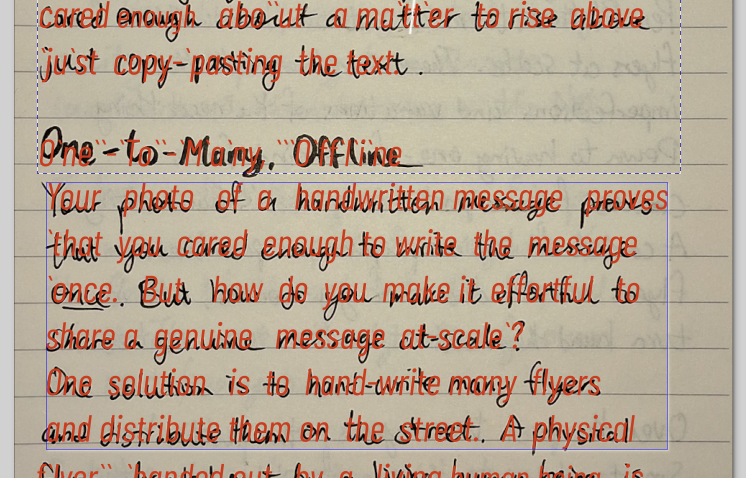
Pictured: overlaid + spaced out text. Notice the ` spacers and extra spaces.

The font (Barlow Condensed – Italic Condensed) and the line height roughly match my handwriting’s dimensions. For spacing, the idea was that I’d add spacing characters that’ll be removed in Javascript during the copy-paste event that fires on the webpage.

I used ` (backtick) characters for narrow spaces that’ll be fully removed, and multiple spaces between words where I planned to collapse them into just 1 space. The hyperlinks are made using Inkscape’s Create Anchor functionality.

After exporting the SVG file, it required some post-processing:

  • Embedding the font using <style>
  • Replacing the ` characters with Six-per-em Space characters so the backticks don’t show up when selected
  • Replacing the linked local image filepaths with full URLs

Finally, the SVG is fully added as an <svg> element into the HTML file. I couldn’t trigger on-copy Javascript events if I embedded it as an <object>.


Get monthly updates. Who’s dating whom on the blog? Who’s my baby’s daddy? Pinocchio vs. Pinochet who wins?