The 1880s were a time of transformation in print – the birth of Graphic Design as we know it.
An all-male cast of typesetters, compositors and apprentices showed off their finest work in the pages of an international “exchange” where their prints would be seen and judged.
One remarkable woman’s work stood out in this environment.
A few of the ~350 contributions to the PISE Vol. 7
Her name was Wally Prohaska and, alone among male Artistic Printers, she was credited as a designer and compositor in her own right.
Come along on a dive into the history of women printers in the 1800s. We’ll start with Wally’s story and go back in time to learn more about the women who made her work possible.
In it, Jamie wrote that Victorian Artistic Printers were exclusively male. When I read that, I spat out my Mountain Dew so hard that my fedora fell off. Dear reader, I wiped the orange Cheeto crust from my 3-day-old stubble and bellowed a powerful Well Akshuallllllllyyyyyyy!
Now, we’re talking about the 1880s. A time when women were a common sight at the printing house… performing low-paid menial tasks. They would be the ones manually feeding paper into a printing press or working in the book-binding room putting together finished pages.
Composing moveable-type and operating the presses was men’s work, and the Printers’ Trade Union had a long history of blocking women from membership. This is what made Wally’s print works stand out: she was proudly credited as the compositor. Doing men’s work.
Wally Prohaska – Artistic Printer
We know about Wally from her submissions to the Printers’ International Specimen Exchange over the period of 1886 to 1889. Here is an example of her work:
This is strong work. It looks like there are 5 colours, with one being gold. She had to set up 5 printing “formes” that lined up perfectly. One for each colour. The ornate borders are made up of small lead elements, lined up side to side – everything is neat and there are no gaps between these elements. The visually “busy” look is typical of German and Italian printing of the time.
Wally was a compositor at the firm of her relative, Anton Halauska in the small town of Hallein, Austria. A profile of the firm in The British Printer credits her as a co-founder, having started the firm with Halauska in 1882.
If we assume that Wally was a close relative of Anton Halauska, we can look for records of her near Anton’s birthplace of Olmütz. There here is a census document in the Czech Archives that, if it is indeed our Wally’s, shows her birth date as Feb. 15, 1855.
Census document from 1881, possibly linked to Wally’s household
By the same logic, it is possible that Wally came from a family that was involved in the printing trade. There are several maps produced in that region by the lithography firm of “Prohaska a Muller”/Karl Prochaska, at around 1836.
After moving to Hallein and establishing herself as a capable Artistic Printer, in 1888 Wally received a Bronze Medal and a Diploma of Honour as part of the German National Arts and Crafts Exhibition in Munich. This was “for highly commendable efforts to promote job printing.” (as reported in “Buchdrucker-Zeitung” and listed in the official record)
Here are 3 more of Wally’s contributions to the Printers’ International Specimen Exchange (PISE):
As of 1893 Wally was still active, drawing up a map of Vienna that was printed by the Military Geographical Institute (source).
Very little is known about Wally, because the relevant original materials are in German and academics haven’t noticed how remarkable she was. I encourage you to research her on your own and add to the body of knowledge around her!
Side note: There is a word in German for “female typesetter” – Accidenzsetzerin. During my research, I only found 2 uses of that word. One was used to describe Wally.
The other use was in an 1893 passage describing this ad in a Berlin newspaper: “(female) Job typesetter seeks printing house owner for marriage. Offers under W. 33, Berlin, O., Post Office 34.”. I found it funny to consider that this could be a personals ad from Wally herself. But this is unlikely – Wally is always shown as Mrs. Prohaska in her contributions to PISE.
Women in printing: before Wally
Let’s go back in time to learn about women’s involvement in printing before Wally. All the way back to the first half of the 1800s.
50 years before Wally’s time, the most prominent women in printing were owners of print houses. They would not have gotten their hands into typesetting & presswork, but we know several of them were shrewd business operators.
Elizabeth Heard
Elizabeth’s entry into the print business was typical of the few women who owned a printing house: her husband died. John Heard owned the business and she took it on after his death in 1823. Elizabeth, who was 35 at the time, ran the business for at least the following 30 years.
30 years in business is a monumental accomplishment. If you read the history of Raithby Lawrence, one of the most successful printworks of the period (“Raithby Lawrence 1776-1876, 1876-1976” by De Montfort Press), you’ll see them constantly teetering on the edge of bankruptcy. Most people running printing business were into the craft of printing and knew next-to-nothing about finance, marketing or customer service. Perhaps that’s the secret to Elizabeth’s success: she must’ve focused on the business, while her son focused on the craft of printing.
Elizabeth lived and worked at 32 Boscowen Street, Truro in Cornwall. As was common for the time, the 4-storey building hosted her business was on the ground floor, with the 2nd floor acting as warehouse and the remaining 2 floors serving as residences. She held literary and musical ‘salons’ in her home and, throughout her widowhood, led Truro society as Cornwall’s ‘most able and amiable business woman’
Elizabeth’s obituary in the New York Evening Express from 1867 reads:
Mrs. Elizabeth Heard, bookseller, printer, and publisher of the “West Briton” newspaper in England, died last month at her residence in Truro. A correspondent of the London “Bookseller” says of her : “I know of no women connected with the book and newspaper trade who was better known and more respected than Mrs. Heard. She had carried on business in Boscowen street, Truro, for close upon sixty years, and I will venture to state that no commercial gentleman who ever called upon her but would be struck with her great judgment, her courtesy, and the desire which she ever evinced to do unto others as she would be done unto.” Mrs. Heard was the widow of Mr. John Heard, the founder of the business, and lost her husband about forty-five years ago. She was left with a youthful family entirely dependent upon her exertions. She was born in London in the year 1787, her father, Mr. Goodridge, being a successful tradesman. Her mother was from Edinburgh.
Like Elizabeth, Ann Eccles succeeded her husband George in their Fenchurch Street printing business when he died in 1838. Here is a poster printed by her firm, and a “dinner programme” submitted by her firm to the Printers’ International Specimen Exchange 37 years later.
Notice the difference in style between the two pieces. It is the progression from old-style printing (limited fonts, centre-aligned) to Artistic Printing (asymmetrical, an abundance of fonts and printers’ decorations).
We have a few more contributions from workers at Ann Eccles’ firm to the PISE. From Vol. 4 (1883):
And an example of a musical-theatre programme from 1887:
Mary Franklin of Hungerford was another woman who followed the same trajectory as Elizabeth and Ann. She took over the business from her husband in 1864 and ran it with her son until 1871. Mary’s business was not just a print house, but also a stationer, bookseller and “circulating library” among other things. This is common in the period: very few people ran a business that was purely a printing house.
An advertisement for Mary Franklin’s printing works (source)A modern photo of 2 Bridge St. in Hungerford, where the Franklins’ print shop was located (source)
Was there an waypoint between the 1840s – when women like Elizabeth Heard could run a print shop, but wouldn’t typeset – and the 1880s when you see Wally Prohaska do modern print work as compositor and designer?
Yes. In the 1860s, one woman did the pioneering work of cracking open the printing guild to women so they could work as typesetters.
In the 1860s, Emily Faithfull wanted to create ways for women to become financially independent. In Emily’s mind, the fact that marriage was a woman’s only path to financial security was responsible for women languishing in loveless marriages – or suffering at the hands of abusive husbands. If women could earn their own keep, how much better would their their life be?!
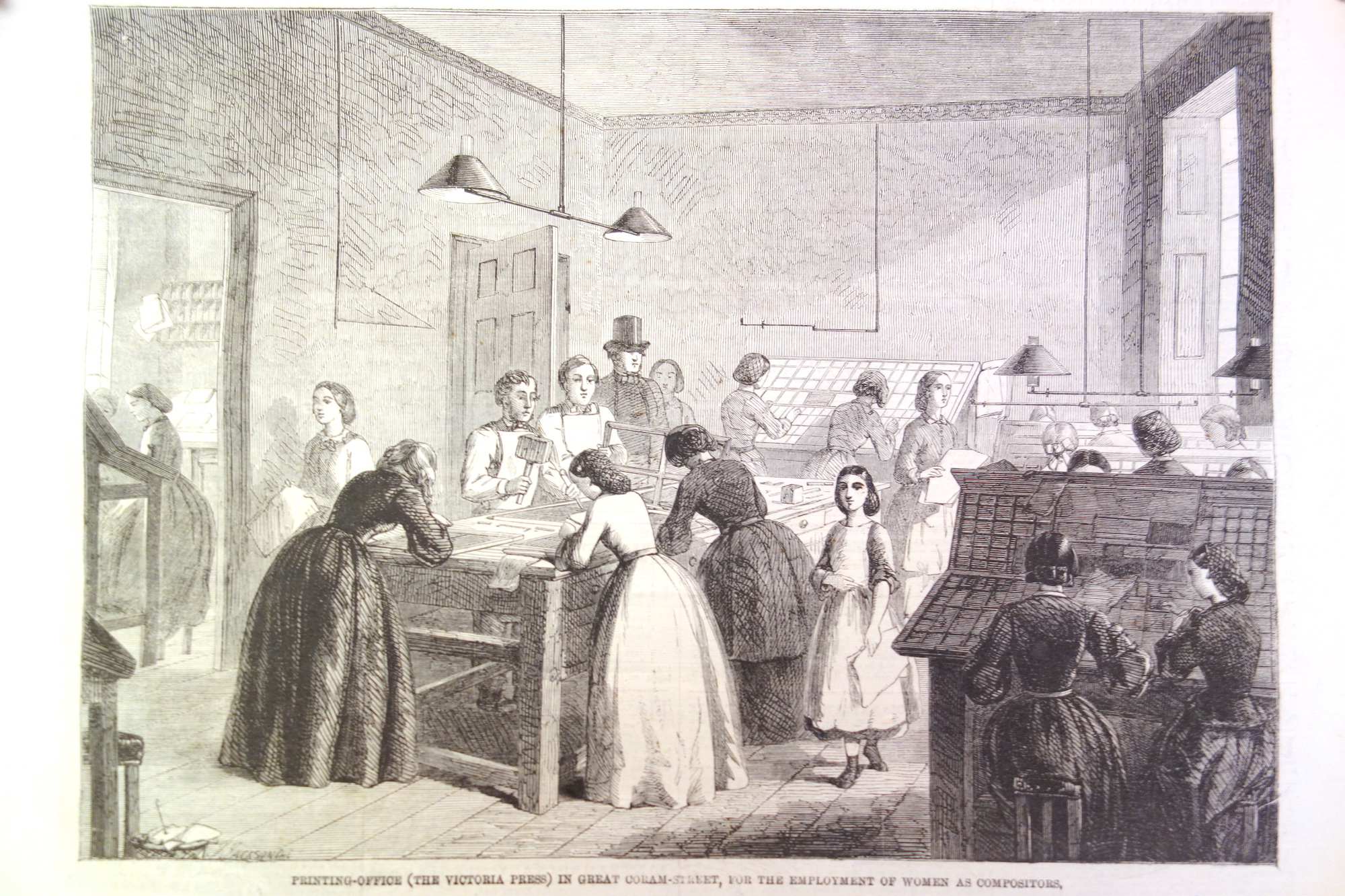
Emily’s approach wasn’t to beg politicians for change, to protest or to set fires. She had a very practical attitude. First, she researched which trades were both well-paying and suitable for women. She narrowed in on print compositing. Then, she founded a business – Victoria Press – a printing press operated wholly by women. It was a training ground for women who’d become compositors.
Emily was not a wealthy woman, but she was clever and effective at building support for her cause. She worked over the powerful Queen Victoria through flattery. She named her printworks “Victoria Press” and produced a showcase book named after & dedicated to Queen Victoria.
That showcase book was the “Victoria Regia“. Browse it to see the quality of female typesetters’ work. The initial letters and illustrations were engraved by female engravers.
Eventually, Emily Faithfull became “Printer & Publisher in Ordinary to Her Majesty”. My understanding is that this was an endorsement of Emily, just as it had been for Richard Bentley previously. (I don’t think this meant that “Queen Victoria had all her printing done at Emily’s press”. This is also separate from the role of “King’s Printer” that George Edward Eyre and William Spottiswoode apparently held during Victoria’s reign.)
Emily needed to entice ordinary women into the compositing profession. To that end, she published “Women Compositors: A Guide To The Composing Room” – a great laywoman’s introduction to the the job and the distinct tasks involved.
Finally, Ms. Faithfull carriedon a constant battle with the men of the printing guild. More on that in her own words:
But when I first attempted to introduce women as compositors, it was still no easy matter to overcome the opposition of the trades-union. As Mr. Gladstone said in his speech on monopolies, “The printer’s monopoly is a powerful combination, which has for its first principle that no woman shall be employed — for reasons obvious enough — viz., that women are admirably suited for that trade, having a niceness of touch which would enable them to handle type better than men.”
The Victoria Press was opened in 1860 in the face of a determined opposition…
The opposition was not only directed against the capitalist, but the girl apprentices were subjected to all kinds of annoyance. Tricks of a most unmanly nature were resorted to, their frames and stools were covered with ink to destroy their dresses unawares, the letters were mixed up in their boxes, and the cases were emptied of “sorts.” The men who were induced to come into the office to work the presses and teach the girls, had to assume false names to avoid detection, as the printers’ union forbade their aiding the obnoxious scheme. … Nevertheless… it accomplished the work for which it was specially designed, for compositors were drafted from it into other printing offices, and the business has been practically opened to women.
You can read more about Emily’s thinking and efforts in founding the press in Emily’s own English Woman’s Journal. Emily was a complex person. In her “Women Compositors” booklet, she exclaims that the profession “is not in any way injurious to health”, but in the English Woman’s Journal article she admits that lead and mercury vapour are a workplace hazard to print-shop employees.
Women printers at Victoria Press (source)Another illustration of Victoria Press(source)
According to Emily’s own Victoria Magazine, her efforts were successful. At around the year of 1876, a census showed 231 women employed as printers in London and about 500 others outside the city, and an additional 113 in Scotland’s main cities.
Note: in the above passage, Emily says that women printers are not prone to Wayzgooses – a printer’s term for “walkabouts” or “fun outings”. Women also don’t celebrate St. Mondays – a slang term for an impromptu holiday that printers took after drinking heavily on a Sunday!
So far, we’ve seen the top-notch typesetting work of Wally Prohaska in 1880s Austria. We went back to the 1840s, when women were entered the print industry – but only as business owners. And finally, we learned how Emily Faithfull set dozens of British women on a career in compositing in the 1860s.
Let’s go forward in time again, to 1892, and hear from two more women in print.
In 1891 William Morris was setting up Kelmscott Press (which was going to absolutely rock the world of artistic printing). At first, he hired William Bowden – a retired master printer – to be the compositor and pressman for the operation. It immediately became obvious that Bowden needed help. In a couple of weeks he was joined by his son William Henry Bowden and daughter Jane Elizabeth Bowden.
Like many women in print, Jane must’ve learned the trade from her father because of the printers’ general hostility to women in the profession. Jane, though, would go on to to become the first woman to be inducted into the London Society of Compositors. When the LSC came to unionize the Kelmscott shop, the employees insisted that they would either all join as members, or not at all:
When the Union authorities approached the men, the latter discussed the whole question, in chapel assembled, and agreed to go in as a “shop” but only as a “shop.” That is to say, there must be no discrimination against non-union men, who must go in on the same terms as the others who were already members, and also that Mrs. Pine must be enrolled with all the rest. No woman had ever yet been admitted to the Union, and its authorities objected to setting up a precedent on the point. The men stuck to their guns, however, and carried the day. Mrs. Pine duly becamethe first woman-member of the L.S.C., though she did not long enjoy the honour, as she followed her father into retirement soon afterwards, but she had made her name historic and opened the way for others.
Miss Linnett is twenty-three years of age, and has worked at the case for nearly nine years. She is the eldest daughter of Mr. J. W. Linnett, an old and experienced journalist well known in the Midland counties, and has an elder brother also connected with the provincial press. She acquired her practical training in the office of the Kettering Observer, of which paper her father was then editor and proprietor, assisting occasionally in the lighter reporting. Miss Linnett has spent the last three years in the metropolis, and is now on the staff of the Theosophical Society, at their printing works in St. John’s-wood.
Amy highlighted that while the printers’ Trade Union would technically permit women’s membership, the Factory Acts placed enormous practical limits on female printers. The Acts treated women the same as child-labour. They were forbidden to work after 6pm and past 2pm on Saturdays. A huge drawback when you’re working in Job Printing shops with unexpected “crunch times” or at a newspaper that’s typeset and printed at night.
Unfortunately, in Amy’s time – 30 years after the founding of Victoria Press – print shop owners who employed women would still face criticism. The fight for equal wages for women compositors continued:
Wherever women compositors were employed on a wide scale, male printers were unanimous in regarding them as an important cause of union weakness and of unemployment in their own ranks. In this context, it is hardly surprising the typographical unions made opposition to the use of women compositors one of the cornerstones of their trade policy. The unions were normally careful, however, to proclaim their opposition to underpaid female labour rather than to women per-se though remarks were occasionally made about the inappropriateness of women doing ‘men’s work.
“Wally” is possibly short for “Walburga”. Her last name might appear as Prochaska, Prochazka or even “Prohasta” (an OCR error, where the German blackletter K looks like the English letter T).
Mrs. M Westwood of Newport, Salop. Here is a specimen submitted to PISE vol. 8 by her employee Thomas Ralphs. It looks like Thomas is playing with the printers’ slang term “coffin” by presenting himself as an undertaker.
Many European languages have gendered forms for words, try searching digital archives for those female variants of “typesetter”, “printer” and “compositor”.
It is true that here and there women had gained a footing in printing-offices before this. It is even said that the original document of the Declaration of Independence was printed by a lady, one Mary Catherine Goddard. Penelope Russell succeeded her husband in printing The Censor at Boston in 1771; and it is recorded that she not only set type rapidly at case, but often would set up short sketches without any copy at all, “a feat of memory,” says the American newspaper reporter, “rivalling those attributed to Bret Harte while on the Pacific coast.” Mrs. Jane Atkin, of Boston, was also noted in 1802 as a thorough printer and most accurate proof-reader. Several English solitary cases might be cited, and one or two attempts — notably at M’Corquodale’s printing-offices — had been made on a small scale previous to the opening of the Victoria Press.
For more on Emily Faithfull
Emily Faithfull is well known and it is easy to find writing about her and from her.
There is a freely-available digital book about Emily Faithfull called The Caxton of Her Age. (A terrible book title – it is a reference to William Caxton)
In the 1870s, Emily Faithfull and Emma Paterson founded the Women’s Printing Society, a publishing house that allowed women to learn the trade of printing. Elizabeth Yeats studied at the Society before founding Dun Emer Press / Cuala Pressin the early 1900s.
For more abut the Victoria Press, visit The Victoria Press Circle. It is a database of the books/magazines printed there, with information about those who contributed their writings and plots of connections between them.
Emily’s sister, Esther Faithfull Fleet was an accomplished illustrator. Te Deum Laudamus is an art book illustrated by Esther, printed by Emily Faithfull. Chromolithographed by Michael & Nicholas Hanhart. My understanding is that older sister Esther painted the illustrations on paper, they were etched on stone by the Hanharts, and then Emily’s team used the stones to print colour prints and bind them into books.
The thesis above shows Eccles’ and Heard’s poster work for boosting immigration to New Zealand. In the first half of the 1800s, London was covered with a baffling number of posters. Their printing work had to stand out this environment:
Detail from John Parry’s 1840 painting, “A London Street Scene”Bills on a wall, 1888. Source.
A cute ad
I like this printed specimen of an ad from the1885 PISE. It’s an advertisement for Mrs. Kirkland’s shirtmaking business, contributed by Isaac Kirkland. Maybe he’s a husband making an ad for his wife, or a son making a flyer for his mom. Nice and heartwarming.
Amy Linnett’s 1892 profile described her as working at the Theosophical Society. If you want to go down a fantastic rabbit hole, start reading the Wikipedia page for Jiddu Krishnamurti – the “World Teacher” that the Theosophists were expecting. It has wonderful passages like:
The boy was vague, uncertain, woolly; he didn’t seem to care what was happening. He was like a vessel with a large hole in it, whatever was put in, went through, nothing remained.
Krishnamurti himself described his state of mind as a young boy: “No thought entered his mind. He was watching and listening and nothing else. Thought with its associations never arose. There was no image-making. He often attempted to think but no thought would come.”
Did you find this page useful? Discovered specimens of women’s printing you’d like to highlight? Wrote a related blog post? Reach out to me by email at jacob at this site!
If you loved this post you’ll superlove my monthly emails ✉️