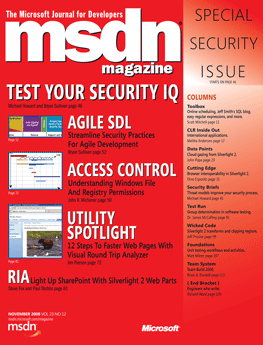
 November 2008
Security Quiz:
Test Your Security IQ
Our security experts present 10 vulnerable pieces of code. Your mission is to find the holes (a.k.a. bad security practices) in the code.
Agile SDL: Streamline Security Practices For Agile DevelopmentBryan Sullivan discusses the new SDL for Web applications and Agile projects with more compressed release cycles.
Access Control: Understanding Windows File And Registry PermissionsUnderstanding the ACLs that govern permissions and rights before an operation is allowed to proceed is critical to enhancing security.
Utility Spotlight: 12 Steps To Faster Web Pages With Visual Round Trip AnalyzerDownload Visual Round-trip Analyzer (VRTA) to uncover the root of your Web page loading problems and identify these 12 common ailments.
RIA: Light Up SharePoint With Silverlight 2 Web PartsFind out how to integrate SharePoint and Silverlight by creating a Silverlight media player and deploying it as a SharePoint Web Part.
Columns
|
Editor's Note:
Can I See Some Identification?: Security measures are highly context driven and change with circumstances. This month Howard Dierking spins a few security yarns to illustrate. |
Toolbox:
Online Scheduling, Jeff Smith’s SQL Blog, Easy Regular Expressions, And More: This month Scott looks at improving development skills, writing regular expressions, a web scheduling control and a SQL tips blog. |
CLR Inside Out:
International Applications: The CLR team takes a look inside the System.Globalization namespace to explain how to handle data formats for proper localization and globalization. |
|
Data Points:
Cloud Gazing From Silverlight 2: John Papa tackles questions about calling services from Silverlight 2 applications. |
Cutting Edge:
Browser Interoperability In Silverlight 2: This month Dino Esposito explains how the browser interoperability layer in Silverlight addresses a number of your Silverlight / Web page interaction needs. |
Security Briefs:
Threat Models Improve Your Security Process: Using threat models to drive your security engineering process helps prioritize the code review, fuzz testing, and attack surface analysis tasks. |
|
Test Run:
Group Determination In Software Testing: There is a large body of research on group techniques to determine the best alternative from a set of options. Dr. James McCaffrey outlines five of them. |
Wicked Code:
Silverlight 2 Transforms And Clipping Regions: Silverlight is powerful enough to let you easily build an image magnification feature for you web site with very little code, most of which is XAML. Find out how. |
Foundations:
Unit Testing Workflows And Activities: Matt Milner takes a look at some of the challenges and techniques related to testing Windows Workflow Foundation activities, workflows, and associated components. |
|
Team System:
Team Build 2008: Brian Randell introduces you to Visual Studio 2008 Team Foundation Server Build (Team Build). Then he creates and runs a team build. |
{ End Bracket }:
Engineers Who Write: Writing is good exercise for developers and software engineers. Richard Ward explains how writing can help you focus your thoughts and communicate more precisely. |